
For buyers of an Italian company, and the advisers who assist them
The target’s tax signals, read from its Cassetto Fiscale before you sign.
When you buy a company, the financial statements describe the year that closed and the data room holds documents prepared for the deal. The Cassetto Fiscale, the company’s tax drawer at the Agenzia delle Entrate (the Italian Revenue Agency), keeps what the company sent to the State and what the State sent back. FiscalPulse reads up to five years of the target’s invoices, payments, returns and letters and puts them in a report: debts to the tax authorities, real revenue, declared financial structure and staff.
€29 a month per company · activated with the target’s credentials · volumes of a hundred companies or more: demo
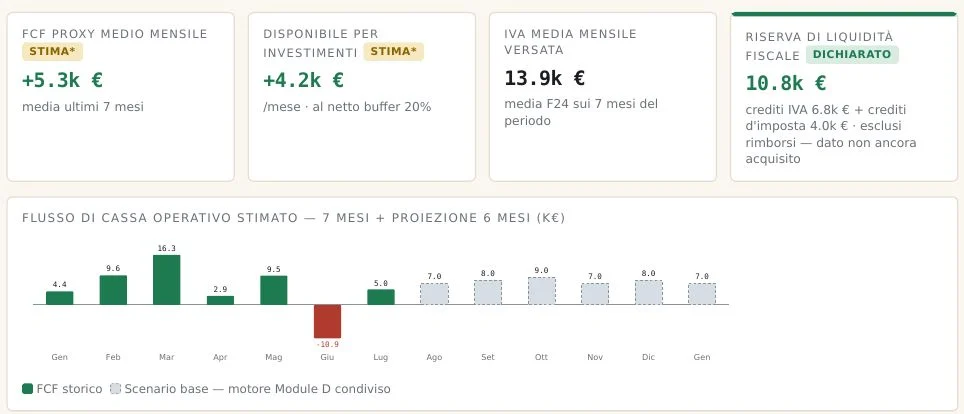 Sample company · illustrative data
Seven checks before closing
Debts to the State, and numbers that hold up in negotiation
Tax credits that are part of the value
VAT credits, tax credits and refunds already recognised to the target, including those withheld or used in an offset.
Read more
They are an asset the accounts often do not separate, and they enter the price only if someone measures them.
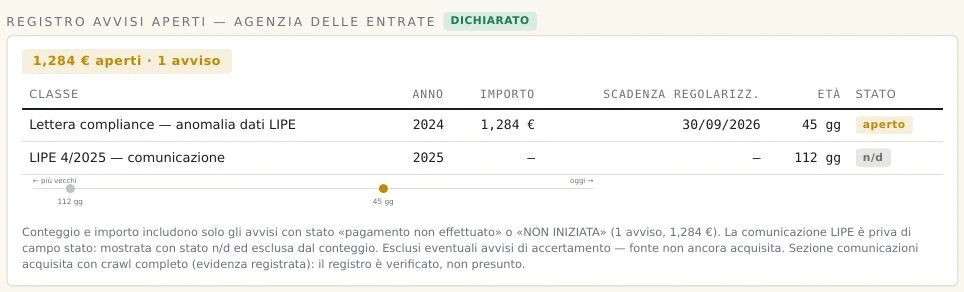
Debts to the State: VAT arrears, notices, instalment plans
VAT declared and left unpaid in earlier years, from section VQ of the annual VAT return; open notices with amount and age; instalment plans with the instalments left, read from the F24 tax payment forms.
Read more
These are tax debts the financial statements may not show yet. The check belongs before signing, while it can still be reflected in the price.
Revenue bridge €663.0k →
€750.0k
Sample company · illustrative data
Real and recurring revenue, customers gained and lost
Monthly revenue from e-invoices, compared with what was declared in the LIPE (quarterly VAT return).
Read more
The revenue bridge shows how much growth comes from new customers and how much was lost with those who left, and the recurring share tells you how much of the turnover you can count on after the acquisition too.
What remains if the main customer leaves
Before paying a multiple on revenue, it helps to know how much of it rests on a single relationship.
Read more
The report measures customer concentration month by month and simulates three losses: the main recurring customer, a quarter of recurring revenue, all recurring revenue.
Payroll cost checked on three sources, and leverage from the tax return
Payroll cost is rebuilt from contributions paid by F24 and checked against the CU employee certificates and the 770 withholding return, with headcount counted from the certificates.
Read more
The income tax return adds interest expense (line RF118), equity and leverage (section RS): a picture of debt more recent than the financial statements in the data room.
How far the declared numbers hold
For each quarter the report sets revenue and VAT from the LIPE next to the same figures rebuilt from invoices and receipts, and prints the difference.
Read more
Every number carries its badge: declared, measured from the documents, or estimated.
An update before closing
Between signing and closing there are weeks, sometimes months.
Read more
The report is updated every month, with a final version on the 18th, and writes to you if the Agenzia sends the target a letter in the meantime. You reach closing with the previous month’s numbers.
The fiscal credit score is a complementary tool based on declared tax data. It is not a regulated credit rating within the meaning of Regulation (EC) No 1060/2009.
The financial statements cover the year that closed. The Cassetto Fiscale reaches last month.
Invoices, F24 payments and letters from the Agenzia reach the Cassetto Fiscale within days, the LIPE in about two months, filed financial statements twelve to eighteen months after the facts.
Read more
In an acquisition, the surprises sit in that gap. The report narrows it and brings you the previous month’s numbers.
Activated with the access the target grants
The report is activated with the target company’s Entratel or Fisconline credentials, or through one of our partner accountants that the target appoints for read-only access. No data is read without the target’s authorisation, and it can revoke the read-only access whenever it wants. Activation takes about half an hour; the first reading covers the whole history available and the report goes to the people the target names.
Questions
What do you check in a tax due diligence on an Italian SME?
Debts to the tax authorities, VAT and social security payments, notices and instalment plans, declared figures against documents, tax credits and payroll cost. The report reads all of this from the target’s Cassetto Fiscale and puts it in one document, with the source and year next to every number.
Can you read an Italian company’s Cassetto Fiscale without its consent?
No. Access comes from the target, with its credentials or by appointing a partner accountant, and it can revoke it at any time. That is why the report is activated once negotiations are under way and the parties have agreed on the review, and it goes to the people the target names.
How many years of tax history can you read?
Up to five years, as far back as the Cassetto Fiscale keeps documents. From the first report you find the comparison with the previous year, how regularly VAT and INPS (social security) payments were made over the last three years, declared VAT arrears and the history of letters received.
Does the report replace the advisers’ due diligence?
No, it supports and speeds it up. It is an analysis tool that puts the target’s tax documents in order and measures inconsistencies. Assessments, contractual warranties and conclusions stay with your advisers, who start from a base already read and can spend their time on the points that matter.
How much does it cost for a single acquisition?
€29 a month, or €289 a year, for a company with up to 2,000 invoices a year, and you cancel after closing. Activation takes about half an hour. For those assessing a hundred companies or more there is a demo of the engine, with a proposal sized on volumes.