
Split payment leaves you the VAT credit. See it monthly.
FiscalPulse reads your Cassetto Fiscale monthly: VAT credit, refunds, open notices, clients, F24.
€29 a month · no installation · read-only, revocable

 Sample company · illustrative data
30 June 2029
Split payment’s announced extension runs to this date.
Read more
It comes from the Italian Ministry of Economy and Finance. Under split payment the public body pays the supplier the net amount and pays the VAT straight to the Treasury.
Source: DPR 633/1972, art. 17-ter; MEF press release no. 77 of 30 June 2026, reported by ANCE, July 2026
0.50%
Withheld from every progress payment until final acceptance.
Read more
The contracting authority holds it back and releases it only at the end of the contract, after final acceptance testing and a clean DURC (the social security compliance certificate).
Source: D.Lgs. 36/2023, art. 11 c.6; lavoripubblici.it, April 2026
€5,000
Above this, a final, confirmed tax debt bars you from public tenders.
Read more
For debts not yet final the threshold is 10% of the contract value, and never less than €35,000.
Source: D.Lgs. 36/2023, arts. 94-95 and Annex II.10; codiceappalti.it
In the report
Credit, tenders and clients
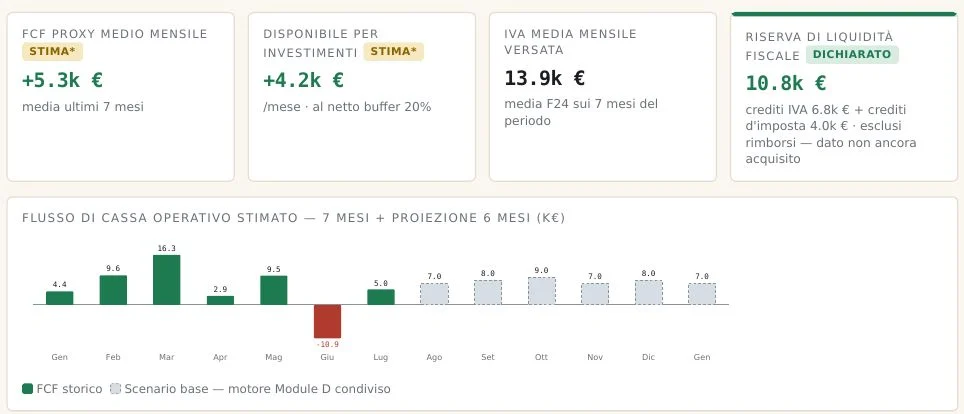
Split payment’s permanent VAT credit
You collect no VAT on public invoices.
Read more
You still pay it on materials, plant hire and services. This applies to public bodies and the companies they control. The report keeps the credit in a fiscal liquidity reserve updated every month and follows each VAT refund from claim to payment: if one stalls, or gets offset against an old debt, you know straight away.
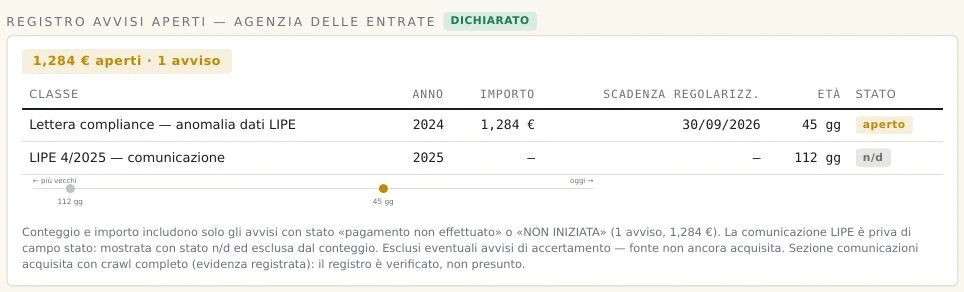
Notices settled before tenders
Know your open tax debts before bidding.
Read more
The report lists every notice from the Agenzia with amount and deadline, and every instalment plan with the payments left. An avviso bonario (the Agenzia’s notice of irregularity) paid within 60 days costs a third of the penalty and never reaches the collection agency. The tax compliance certificate is issued by the Agenzia; with the report you know before asking what needs sorting out.
Top client 45% of revenue, HHI 2,860
Roads and motorways €11.83M · bridges and tunnels €1.89M
Loss of the main recurring client
€2.27M, 9.0% of revenue
Sample company · illustrative data
Each public client’s weight
A few clients make up most revenue.
Read more
That is typical of public works, with public bodies, consortia and concession holders. Every month the report measures the share of the largest one, splits revenue by type of work and calculates how much revenue remains if the main recurring client stops.
Numbers for guarantees
Your tax score, ready when a tender needs guarantees.
Read more
For a credit line with banks and confidi you also have VAT and INPS (social security) regularity and last month’s figures, without rebuilding the picture by hand. Confidi are Italian credit guarantee consortia.
The tax credit score is a complementary tool based on declared tax data. It is not a credit rating regulated under Regulation (EC) No 1060/2009.
F24 dates and payments on account
Every F24 due, with its date.
Read more
This month’s VAT, contributions and the estimated IRES (corporate income tax) payment on account sit next to the lease instalments on your machinery. The F24 is the Italian tax payment form.
Deferred SAL and collection times
Deferred SAL invoices are tracked separately.
Read more
Immediate ones sit on their own line. SAL (stato avanzamento lavori) is the progress invoice for work completed. Collection times are estimated client by client. In the sample, 72.8% of revenue comes from deferred invoices.
LIPE matched to invoices
Each quarter, LIPE VAT is checked against invoices.
Read more
The LIPE is the quarterly VAT return. These are the same data the Agenzia cross-checks before sending compliance letters.
Proof you followed the accounts
Every report stays archived as generated.
Read more
It keeps that month’s early-warning indicators. A director can show that warning signs were noticed in time.
Giulia shows what is inside and what reaches you every month.
Split payment makes the VAT credit permanent.
Public bodies pay the VAT straight to the Treasury.
Read more
They pay you the net amount. Meanwhile the company pays VAT on materials, plant hire and services, so a credit forms with every invoice and never closes on its own. It is recovered by offsetting it in the F24 or through a refund, and for VAT on split payment sales, suppliers to the public sector have a priority refund lane. On top of that, the contracting authority holds back 0.50% of every progress payment until final acceptance. The report lines it all up every month: credit built up, credit used in the F24, refunds claimed and refunds paid.
Source: DPR 633/1972, art. 17-ter; L. 190/2014, art. 1 c.630 and DM 23 January 2015, art. 8 (EC News, 2017); D.Lgs. 36/2023, art. 11 c.6
Who it is for, by ATECO code
- Roads, motorways, runwaysATECO 42.11
- Railways and underground linesATECO 42.12
- Bridges and tunnelsATECO 42.13
- Water, sewer, gas networksATECO 42.21
- Power and telecom networksATECO 42.22
- Water projectsATECO 42.91
- Other civil engineeringATECO 42.99
- Any firm invoicing public bodies under split payment
Getting started
Set up in about half an hour, then it runs on its own
- 01
You give us access to the Cassetto Fiscale.
The company’s Entratel or Fisconline credentials are enough: these are the logins an Italian company uses with the Agenzia delle Entrate.
Read more
If you do not have them, we request them together through the company’s PEC, its certified email address, and they arrive in four to seven days. You can also appoint one of our partner accountants in Italy for read-only access.
- 02
We read the full history.
Invoices, F24 payments, LIPE, tax returns, letters from the Agenzia and credit registers: twenty-two document types, joined into a single reading.
- 03
You receive the report every month, in English.
A provisional version on the 3rd and the final one on the 18th, archived and ready to download.
Read more
You also get an email every time the Agenzia writes to the company.
Your accountant in Italy keeps doing their job. If you like, they receive the report in copy.
€29 a month per Italian company, with the company’s own credentials
for companies with up to 2,000 invoices a year · cancel whenever you like
Cancel whenever you like, with no penalty. The yearly plan is paid in one instalment.
- Full monthly report, provisional on the 3rd and final on the 18th
- An email for every letter from the Agenzia, with the original attached and explained in English
- A reminder before every deadline
- Alerts on out-of-scale invoices and on customers who are buying less
- A version of the report to present to Italian banks and confidi (credit guarantee consortia)
- Archive of every past report, always available to download
By subscribing you accept the Terms of Service.
A hundred companies or more. Banks, leasing and factoring companies, credit guarantee consortia, networks and groups that follow at least a hundred Italian companies: we show you the engine in a demo on real positions from your portfolio.
An Italian company spends between €5,000 and €50,000 a year on its accountant, admin staff and software to produce the data that lands in the Cassetto Fiscale. For €29 a month, that data works for you too.
Questions
Does split payment always create VAT credit?
Almost always, when most revenue comes from public bodies. The public body pays the VAT on your invoices, while you pay VAT on purchases: the credit builds up and has to be recovered by offset or refund. Every month the report shows how much credit you have, how much you have used in F24 payments and where each refund stands.
Do public-sector suppliers get faster VAT refunds?
Yes, through a priority lane limited to the VAT on split payment sales. The average-rate test still applies: the rate on purchases must exceed the rate on sales increased by 10%, with a credit above €2,582.28. The rest of the credit follows ordinary timing, and the report follows each refund until it is paid.
Source: L. 190/2014, art. 1 c.630; DM 23 January 2015, art. 8; EC News, 2017 and 2018
Which tax debts exclude you from tenders?
A final, confirmed debt above €5,000. For debts not yet final the threshold is 10% of the contract value and at least €35,000, excluding penalties and interest. The report keeps open notices and instalment plans in view, so the tender office knows what to settle before requesting the certificate.
Source: D.Lgs. 36/2023, Annex II.10; codiceappalti.it
How long do public bodies take to pay?
In 2024 the weighted average was 30 days from invoice, according to Ministry of Economy and Finance data, with 81.5% of amounts paid on time. The Catholic University’s public accounts observatory considers these figures underestimated, and the builders’ association reports four to five months for construction. The report estimates collection times client by client.
Source: MEF data analysed by the Osservatorio sui conti pubblici italiani, Università Cattolica, September 2025; ANCE, November 2023
Do public-body invoices reach the Cassetto Fiscale?
Yes. They are FatturaPA e-invoices, the format required for public bodies, sent through SDI (the national e-invoicing exchange) with the receiving office’s code. They land in the Cassetto Fiscale like any other e-invoice, marked as split payment VAT. The report reads them with F24 payments, LIPE and letters from the Agenzia, so public and private revenue sit on one page.