
How we read the numbers
How much has to leave the bank account by the 16th, and what is the year worth?
These are two separate questions. The cash basis (cassa in Italian) follows money on the day it leaves. The accrual basis (competenza) assigns each cost and each tax to the period it belongs to. The Cassetto Fiscale, the company’s tax drawer at the Agenzia delle Entrate (the Italian Revenue Agency), holds the documents for both. FiscalPulse does both sums and states where every figure comes from.
IRES, two separate values
cash €14.8k, accrual €32.4k on CPB basis
Sample company · illustrative data
The same tax, two figures that are not meant to match
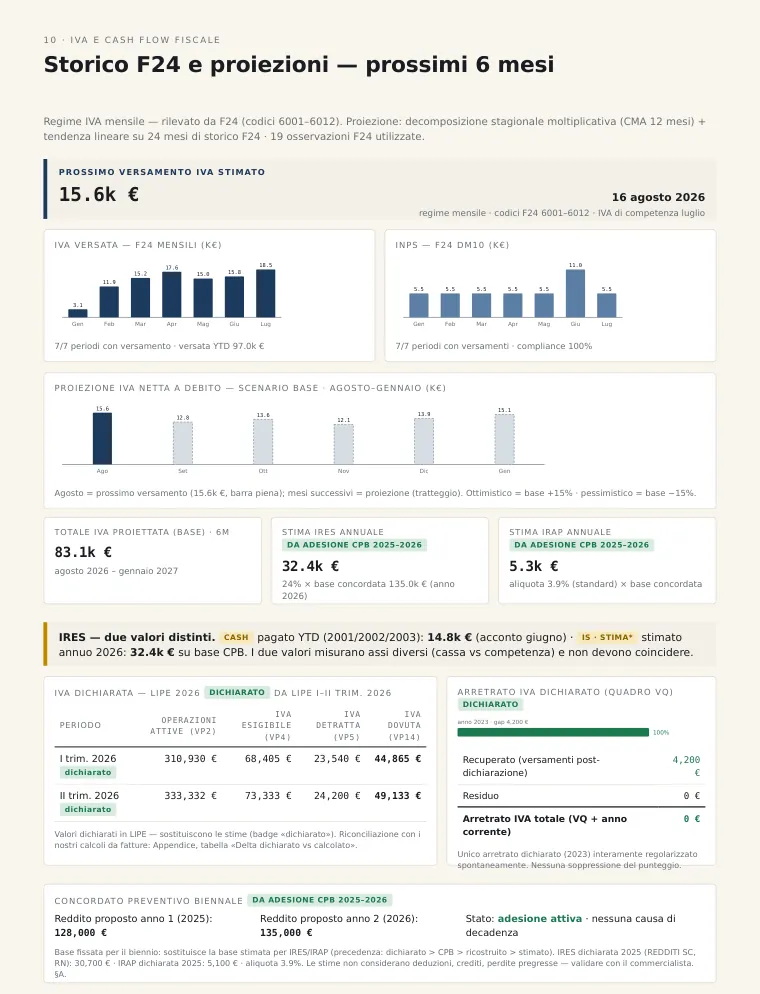
Take the IRES, the 24% corporate income tax, of a sample company: a software house with nine employees. The year’s F24 payments (the single form for Italian taxes and contributions) carrying the corporate income tax codes show €14,800 paid with the June advance, and the report has already put the second advance instalment in the calendar: €19,440 by 30 November. That is the cash view, money leaving the account on fixed dates.
Read more
The tax that belongs to 2026 is a different figure. The company joined the concordato preventivo biennale (CPB, a two-year advance agreement with the Agenzia on taxable income) with agreed income of €135,000 for 2026. At 24% that gives €32,400. That is the accrual view: what the year is worth for tax purposes.
Advances run on their own calendar and their own calculation base, while the tax follows the year’s income, and the balancing payment settles the gap. That is why the report prints them side by side, with a note that the two values measure different things.
IRES, two separate values
Concordato preventivo biennale
IRES advance, 2nd instalment
€19,440
Sample company · illustrative data
IRES 2026 · paid in the year €14,800 (from F24) · second advance instalment €19,440 by 30/11/2026 · annual tax €32,400 (24% × €135,000 agreed, from CPB)
July’s VAT is paid on 16 August
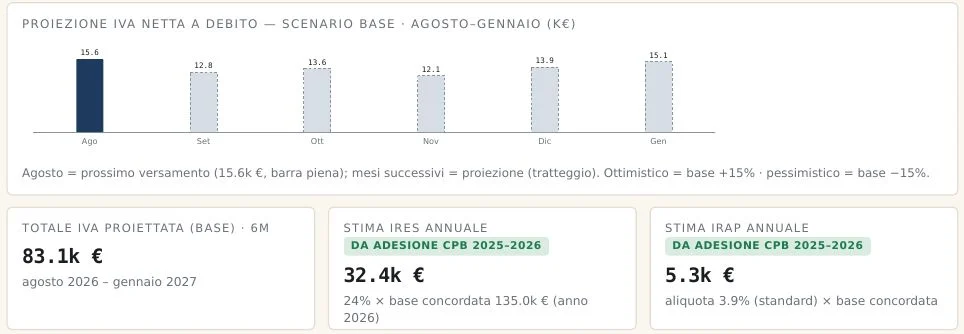
Under the monthly regime, a month’s VAT is paid on the 16th of the following month. The report recognises the regime from the tax codes on F24 payments already made. It works out July’s accrued VAT from the invoices issued and received and places it where it hits cash: €15,600 by 16 August.
Read more
Once the periodic VAT return arrives, the declared figure replaces the calculation. In the example, the LIPE (the quarterly VAT return) for the first quarter declares VAT due of €44,865 and the second-quarter one €49,133. From that point these are the figures the report uses.
Sample company · illustrative data
Next VAT payment €15,600 by 16/08/2026 (July accrued VAT, estimate) · VAT due declared in LIPE: Q1 €44,865, Q2 €49,133
June weighs double, and the report says why
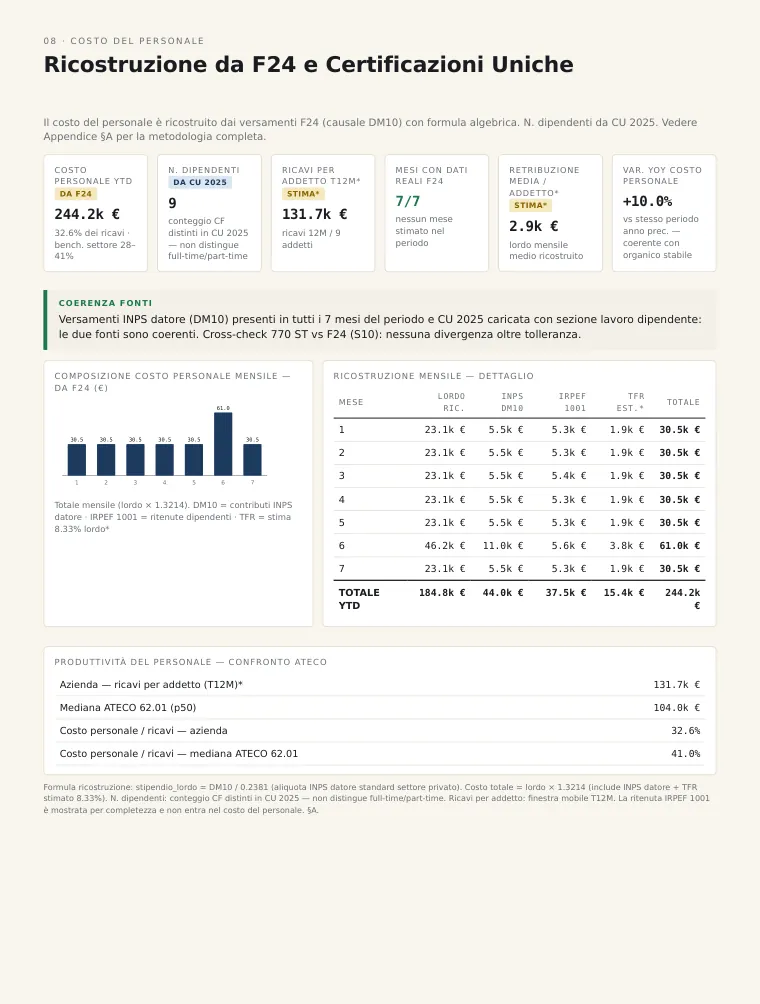
In the profit and loss account, an extra month’s salary belongs to the whole year. In the bank account it leaves in a single month. In the example, payroll cost rebuilt from the F24 payments is about €30,500 a month, and in June, with the extra month’s pay, it rises to €61,000. The estimated cash flow for that month turns negative.
Read more
Read on a cash basis alone, it would look like a bad month. The report explains it as seasonality in payroll cost. On the investment page it points to the months when cash is widest for large purchases, away from June and from December, when the tredicesima (the thirteenth-month salary) is paid.
Sample company · illustrative data
Payroll cost from F24: €30.5k a month, €61.0k in June · estimated cash flow for June −€10.9k · best months to invest: March, February, May
Before any calculation, the right documents
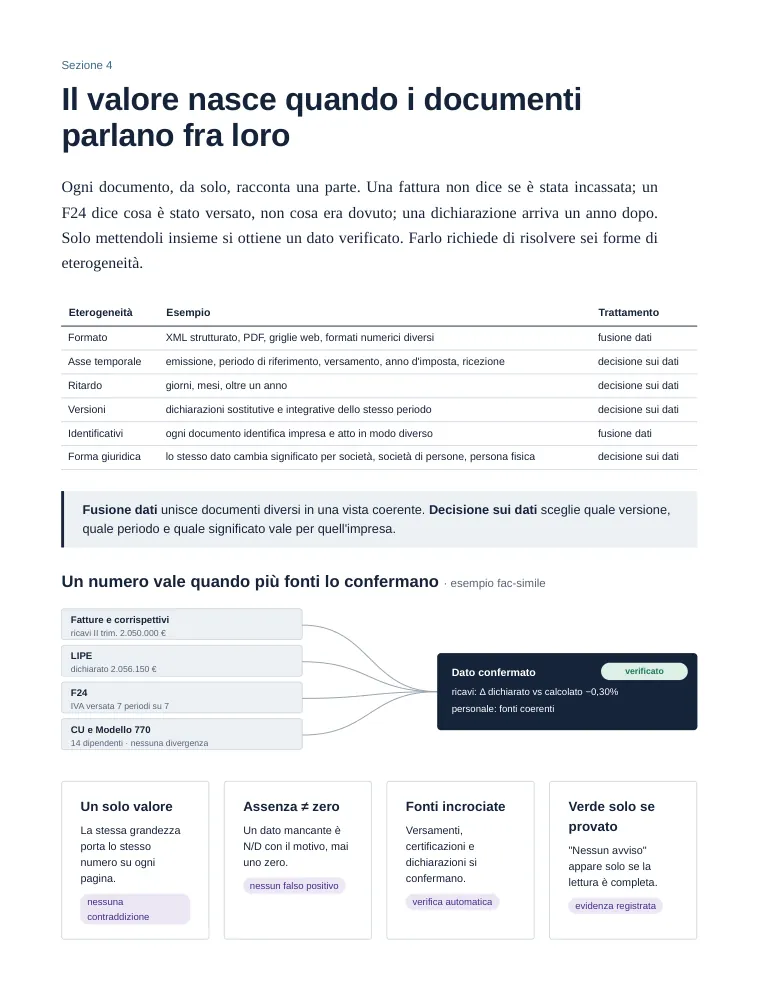
Cash and accrual figures come out right only if every document sits on its own time axis. An invoice has an issue date and a reference period, an F24 a payment date, a tax return a tax year, and sometimes an amended return replaces the first one.
Read more
The most delicate work happens before the formula: reading twenty-two document types, recognising which version counts and bringing every amount back to its proper period. Even the most refined calculation gives reliable figures only when it starts from documents read and ordered this way.
Sample company · illustrative data
On the report page
The panel that puts cash and accrual side by side
On the VAT and taxes page, IRES appears twice, with two different tags: “cash” for what was paid through F24, “estimate” or “from CPB” for the year’s tax.
Read more
Below it, the concordato panel shows the income fixed for the two-year period and the order of precedence of sources: declared, then agreed, then reconstructed, then estimated.
Two figures for two questions: how much you must pay by the 16th, and what the year is worth. The report keeps both and says where each one comes from.
Sample company · illustrative data
Questions
What is the difference between the cash basis and the accrual basis?
The cash basis records income or an outgoing on the day money moves. The accrual basis assigns it to the economic period it belongs to. A company needs both: cash tells you whether the account can meet the deadlines, accrual tells you what the year has earned.
Why is the IRES paid in the year different from the year’s IRES?
Because advances are calculated on a different base from the current year’s income. They follow a fixed calendar, with instalments in June and November, and the difference is settled with the following year’s balancing payment. The report shows the IRES paid, the instalments still due and the accrued tax, each separately and each with its source.
How does the concordato preventivo biennale change the tax calculation?
Once the company joins, the income agreed for the two years replaces the estimate. The report reads it from the Cassetto Fiscale and calculates IRES and IRAP, the regional tax on productive activity, on that base. The tag “from CPB” shows that the figure comes from the agreement with the Agenzia.
Can the report work out accrued taxes without financial statements?
Yes. It uses the declared tax when the return exists, the agreed income when the company has joined the concordato preventivo biennale, and an estimate marked as such only when both are missing. The most certain available source always wins, and every figure in the report shows it with its tag.
When are IRES advances paid in Italy?
In two instalments: the first together with the previous year’s balance, normally by June, the second by 30 November. The report reads from the F24 payments how much has already been paid and puts the next instalment in the deadline calendar, with the amount and the days remaining.
If you would like to see both sums done on your own company’s documents, you can start the report with its Cassetto Fiscale credentials.