
How we read the numbers
The bank account says the money has gone. The Cassetto Fiscale says what it paid for, and what is still owed.
The bank statement and the Cassetto Fiscale, the company’s tax drawer at the Agenzia delle Entrate (the Italian Revenue Agency), look at the same company from two sides. The first records movements, the second their tax meaning. Here is what each one sees, with examples from a report.
Declared VAT arrears (VQ section)
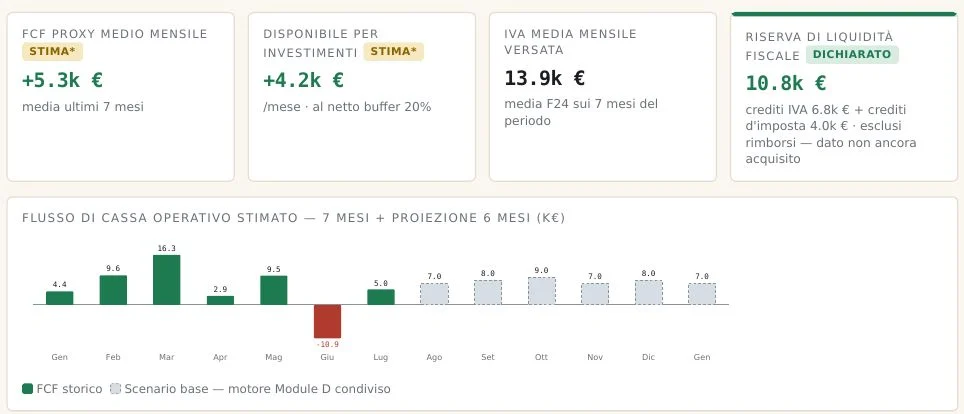
Tax liquidity reserve
€10.8k
Sample company · illustrative data
One F24, two readings
On the bank statement an F24, the single form for Italian taxes and contributions, is one line: a date, the word F24, an amount. In the Cassetto Fiscale the same payment breaks down by tax code: the month’s VAT under codes 6001 to 6012, INPS social security contributions under the DM10 reason code (the employer’s monthly contribution filing), employee withholding under code 1001, tax advances under their own codes.
Read more
From those codes the report works out the company’s VAT regime, payroll cost month by month, how much VAT was paid against what was declared, and whether a late payment was settled through ravvedimento operoso, the voluntary correction with a reduced penalty.
VAT paid, monthly F24
INPS, F24 DM10
Monthly reconstruction, INPS DM10 and IRPEF 1001 columns
Sample company · illustrative data
VAT paid in the first seven months €97,000, 7 periods out of 7 · INPS DM10 contributions €5,500 a month · 1001 withholding about €5,300 a month
What the Cassetto records and the bank account does not see
Some tax facts do not move a single euro until someone deals with them: VAT arrears declared in the VQ section of the annual VAT return, a tax credit granted and not yet used, a letter from the Agenzia with its deadline. The same goes for the ISA score (the Agenzia’s tax reliability index), the VAT number’s status in VIES (the EU register of valid VAT numbers) and the income agreed for the two-year concordato.
Read more
In the sample company, the bank account shows none of the €10,800 in VAT and tax credits already granted, nor the €1,284 letter to settle by 30 September, nor the €4,200 of 2023 VAT arrears, which the company has already recovered through voluntary payments. The Cassetto records them all and the report puts them on the page.
Sample company · illustrative data
Tax liquidity reserve €10,800 (VAT credits €6,800 + tax credits €4,000) · compliance letter €1,284 by 30/09/2026 · 2023 VAT arrears €4,200, 100% recovered · ISA 8.2 · VIES active
What the bank account records and the Cassetto does not see
The bank account knows things that tax documents do not record: the day a customer paid, the available balance, mortgage and loan instalments, the exposure to banks that appears in the Centrale Rischi (the Bank of Italy’s central credit register), guarantees given.
Read more
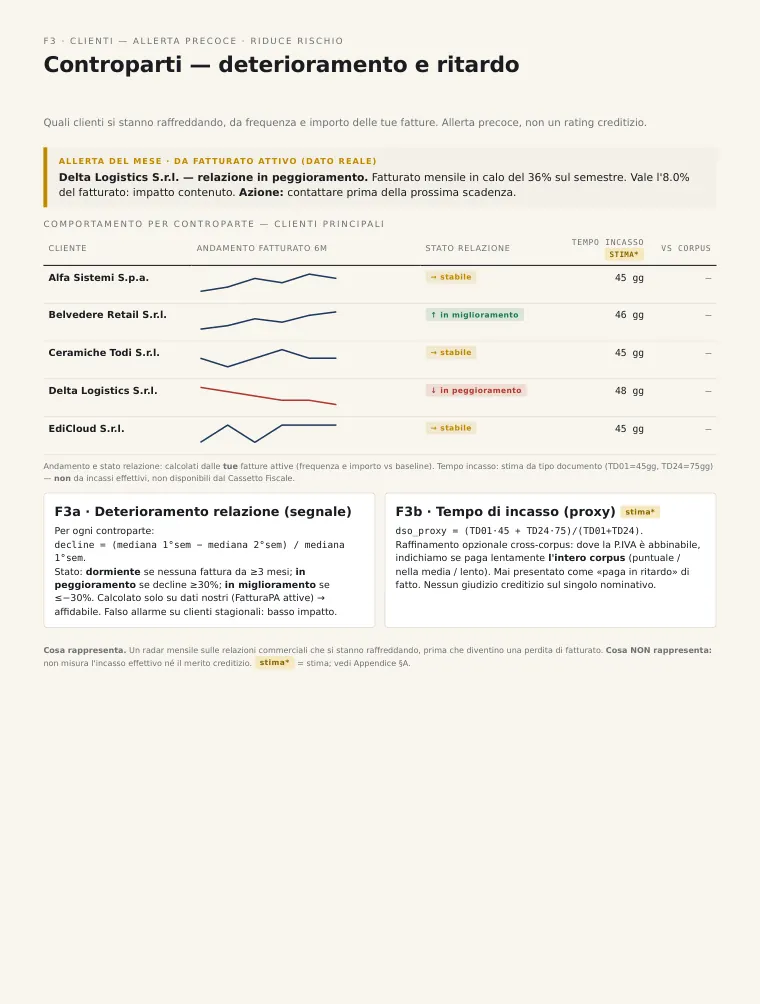
The report says so openly. Collection times, for example, are estimated from the invoice type and marked as an estimate. In the appendix it lists the measures it does not cover, from bank exposure to net financial position.
Sample company · illustrative data
Estimated collection time 45 to 48 days per customer, worked out from the document type · in the appendix: bank exposure, guarantees, net financial position, actual depreciation among the measures the report does not cover
When you need both
For the monthly report, the Cassetto Fiscale credentials are enough. Anyone who also wants the part that runs through the bank account can add analytical accounting, available on request, which reconciles bank movements with invoices and F24 payments.
Read more
With reconciled accounts, collection and payment times are measured on actual dates, in ageing bands of 0 to 30, 31 to 60, 61 to 90 days and beyond. Net financial position and a reclassified profit and loss account are calculated too, and takings from card terminals, cash and finance companies are matched with the invoices.
On the report page
The VAT arrears panel, next to the declared returns
On the VAT page, to the right of the periodic returns, the report shows the arrears declared in the VQ section, how much was recovered with later payments and how much is left.
Read more
It is a debt to the Italian State that appears on no bank statement until it is paid.
The bank says the money has gone. The Cassetto says what it paid for, and what is still owed.
Declared VAT arrears (VQ section)
year 2023, gap €4,200, recovered €4,200, remaining €0
Sample company · illustrative data
Questions
Does the report read the company’s bank accounts?
The monthly report reads only the Cassetto Fiscale, with read-only access, and asks you to connect no bank. If you also want bank movements, you can add analytical accounting, available on request, which reconciles them with invoices and F24 payments and measures collections and payments on actual dates.
What does an F24 tell you that a bank statement does not?
Which tax, contribution or withholding each euro paid relates to, and for which period. From the tax codes the report works out the VAT regime, payroll cost, whether payments match the returns, and any ravvedimento. On the bank statement all of this appears as a single outgoing.
Why does tax data arrive before the financial statements?
Because it reaches the Cassetto Fiscale within days or weeks of the events. Invoices, electronic takings and F24 payments arrive within days, VAT returns after about two months, while filed financial statements arrive twelve to eighteen months late. The report reads tax data every month, while the events are still recent.
How can collection times be estimated without a bank statement?
From the document type, with a weighted average per customer. An immediate invoice and a deferred invoice have different typical collection times, and the report combines the two shares for each customer. The value is marked as an estimate. With analytical accounting on request, the same times are measured on actual collection dates.
What does the Centrale Rischi see that the Cassetto Fiscale does not?
The company’s exposure to banks and financial intermediaries: credit lines, usage and overdrafts. The Cassetto Fiscale records invoices, payments, returns and debts to the State, which the Centrale Rischi does not show. The report reads the Cassetto and states in the appendix that bank exposure is outside its scope, so you know what to add alongside it.
To read your company’s Cassetto Fiscale this way, its credentials are all you need. The bank account stays where it is.