
For private equity and venture capital funds
Every portfolio company read from its Cassetto Fiscale, every month, on the same indicators.
Portfolio company reporting arrives in different formats and on different timetables, and the financial statements describe the previous year. FiscalPulse reads each month the documents every Italian company has already sent to the State, kept in its Cassetto Fiscale (the company’s tax drawer at the Agenzia delle Entrate, the Italian Revenue Agency), and gives you real revenue, debts to the tax authorities, declared financial structure and customer risk, in the same form across the whole portfolio.
€29 a month per portfolio company · each company grants its own read-only access · 100 portfolio companies or more: demo
 Sample company · illustrative data
Seven readings for whoever sits on portfolio company boards
Last month’s revenue, and the oversight that protects the investment
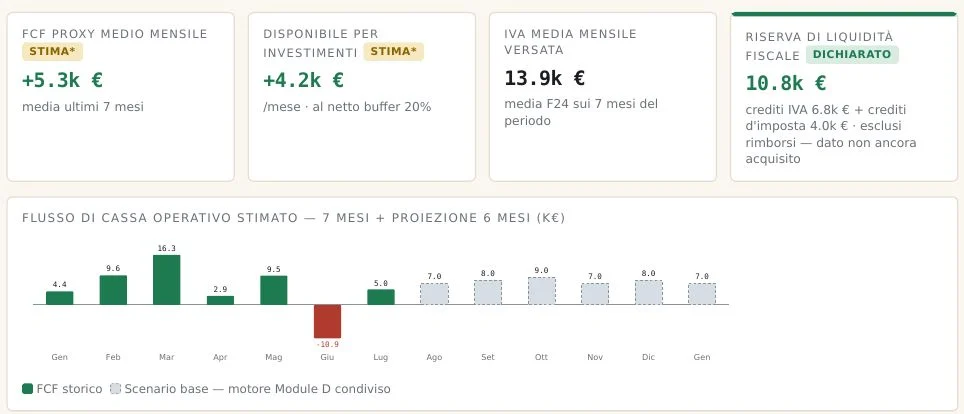
Tax cash sitting idle in each portfolio company
VAT credits, tax credits and refunds already recognised, added up into one reserve for each company, with refunds withheld or offset against a debt still open shown clearly.
Read more
That is cash the company can put back to work without asking for new capital.
Revenue from invoicing, last 12 months against the previous 12 + Declared vs calculated
Sample company · illustrative data
Real monthly revenue, months before the financial statements
Monthly revenue rebuilt from the flow of e-invoices and electronic receipts, compared with what the company declares in the LIPE (quarterly VAT return), with the gap measured.
Read more
For portfolio monitoring you read each company’s trend thirty days after the month closes, while filed financial statements arrive twelve to eighteen months later.
Revenue bridge €663.0k →
€750.0k
Sample company · illustrative data
Customers gained, customers lost, recurring revenue
The revenue bridge separates growth brought by new customers from revenue lost with customers who left, and the share of recurring revenue tells you how much of the turnover truly repeats.
Read more
These are the questions every investment committee asks, answered from the invoices.
VAT arrears and leverage, from the tax returns
Section VQ of the annual VAT return shows VAT declared and left unpaid in earlier years, long before that debt becomes visible outside the company.
Read more
Interest expense from line RF118 and equity from section RS of the corporate tax return give the weight of debt even when the latest available financial statements are old.
Customer concentration and stress test
How much the largest customer weighs, month by month, and how much revenue remains if they leave, if a quarter of recurring revenue goes, or if all of it goes.
Read more
The scenarios are in euros, for every portfolio company.
A score you can compare across portfolio companies
The same six-dimension score for every company in the portfolio, with published weights and a formula you can rebuild by hand.
Read more
The comparison tells you which company presents better to a bank and which deserves attention at the next board meeting.
Letters, instalment plans and the crisis threshold in each company
Every notice from the Agenzia appears with amount, deadline and age, next to the instalment plans in progress.
Read more
If a portfolio company’s overdue VAT nears the €20,000 notification threshold, you know before the board meets, and every month the report records the early-warning indicators that document the company’s adequate organisational arrangements (adeguati assetti).
The fiscal credit score is a complementary tool based on declared tax data. It is not a regulated credit rating within the meaning of Regulation (EC) No 1060/2009.
A portfolio speaks many languages. The Cassetto Fiscale speaks only one.
Before every committee someone reconciles by hand numbers that come from different accounting systems, accountants and closing calendars.
Read more
Since 2019 every invoice between Italian businesses has passed through one national system, and in the Cassetto Fiscale it sits next to F24 payments (the single form for Italian taxes and contributions), returns and letters from the Agenzia. The report starts from those documents and reads every company the same way.
Each portfolio company activates its access, and the report reaches the fund
Each company grants access to its Cassetto Fiscale with its Entratel or Fisconline credentials, or through one of our partner accountants appointed for read-only access, and names the people at the fund who receive the report. Activation takes about half an hour per company. The report arrives on the 3rd as a provisional version and on the 18th as the final one, archived.
Questions
How do you monitor the tax position of a fund’s Italian portfolio companies?
By reading each portfolio company’s Cassetto Fiscale every month, with a report built the same way across the portfolio. Real revenue, VAT arrears, declared leverage, customer concentration, tax score and letters from the Agenzia arrive in the same form, so comparing companies needs no manual reconciliation.
Does tax data arrive before the financial statements?
Yes, by many months. Invoices, receipts, F24 payments and letters from the Agenzia reach the Cassetto Fiscale within days and the LIPE in about two months, while filed financial statements arrive twelve to eighteen months after the facts. The report shows the company as of the previous month, in time for the committee.
Does the portfolio company have to consent?
Yes. Each company grants its own access, with its credentials or by appointing a partner accountant, and decides who receives the report. No tax data is read without the company’s authorisation, and the read-only access can be revoked at any time.
Is the tax score a credit rating?
It is a complementary tool based on declared tax data, with six dimensions and published weights, that you can rebuild by hand. It shows how a lender would read the company and lets you compare portfolio companies with each other. It is not a regulated credit rating within the meaning of Regulation (EC) No 1060/2009.
When does a demo make sense, and when direct activation?
The demo is for funds following a hundred portfolio companies or more: we show you the engine on real companies from your portfolio. Below that, activation is direct, company by company, at €29 a month or €289 a year each, and every portfolio company sets up its own access in half an hour.