
For credit analysts · banks, leasing, factoring, credit guarantee consortia, credit insurers
The financial statements in your credit file describe a company as it was eighteen months ago.
FiscalPulse reads an Italian company’s Cassetto Fiscale, its tax drawer at the Agenzia delle Entrate (the Italian Revenue Agency), with the company’s own read-only authorisation. Every month it gives you revenue, tax payments, letters from the Agenzia and declared VAT arrears, months before the financial statements show them.
Demo for lenders and analysts following 100 companies or more · for a single company, direct activation from €29 a month

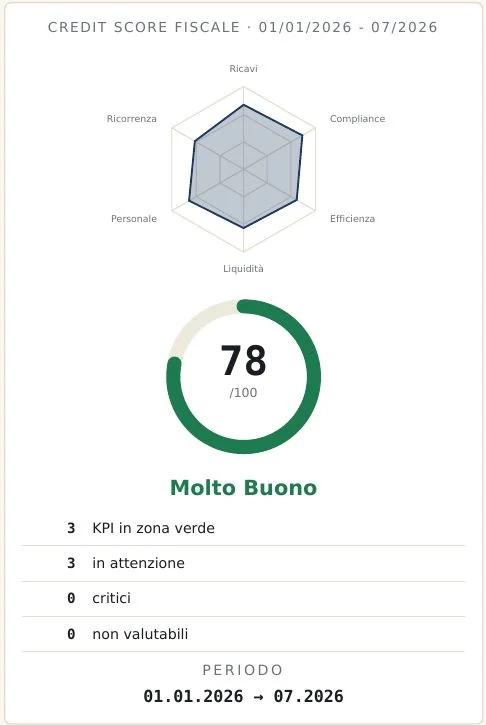 Sample company · illustrative data
5–7 months
ahead of the Centrale Rischi, on a real sample of companies
20,000+
companies processed in five years of production
35M+
tax documents classified
22
document types read from a single authorisation
What goes into your credit file
Eight signals the financial statements will show you next year, read today
Declared vs calculated revenue
Q1 2026 −0.30% · Q2 2026 +0.20%
Sample company · illustrative data
Real monthly revenue, checked against the declared figure
Revenue is rebuilt month by month from the e-invoice flow and compared with the LIPE, the quarterly VAT return.
Read more
The gap between the two is measured company by company, so you know how far to trust the number before it goes to committee.
F24 signals
2 late payments/corrections (2024, regularised) · 7 of 7 VAT periods settled
Sample company · illustrative data
Late payments, voluntary corrections and instalment plans
F24, the form used for every tax and contribution payment, shows late payments, ravvedimenti (voluntary corrections with a reduced penalty) and instalment plans month by month.
Read more
The historical correction record from the 770 withholding return adds the years before the monitoring began.
Five to seven months ahead of the Centrale Rischi
A company that stops paying its VAT does so months before it misses a loan instalment.
Read more
On a real sample of companies, the tax signals appeared five to seven months before the Centrale Rischi, the Bank of Italy’s central credit register, showed anything.
Declared VAT arrears, one to two years before a tax bill
Section VQ of the annual VAT return shows VAT declared and left unpaid, one to two years before it turns into a tax collection notice that lenders can see.
Read more
The report shows the arrears and the payments made to recover them.
Open letters from the Agenzia, with amount and age
Every letter from the Agenzia is matched with the F24 payments: paid, under an instalment plan or still open.
Read more
The report also counts how many letters the same company has received over time, because a growing series usually comes before the tax bill.
Coverage where no financial statements exist
Partnerships and micro companies do not file financial statements.
Read more
Interest expense from line RF118 and equity and leverage from section RS of the tax return give you financial burden and debt weight even without them.
The structure of commercial risk
Customer concentration, customers buying less, recurring revenue and a stress test on the loss of the main customer: how much revenue remains if they leave, in euros.
A score you can rebuild by hand
Six dimensions with published weights.
Read more
When the Agenzia certifies a state of crisis, the score is suspended and the reason is written in the report. Once financial statements become available, each metric is compared with the matching line, so the quality of every number is measured by sector.
Fiscal credit score
Published weights, cited sources, measured quality
For every metric you know whether it was declared to the State, measured from the documents or estimated.
Read more
Where the financial statements become available, the gap is measured metric by metric and by sector, so you know how much weight each number can carry before you use it in committee.
Credit Score Fiscale — 6 dimensioni
Sample company · illustrative data
| Revenue strength | 25% | 78 |
| Tax compliance | 25% | 82 |
| Operating efficiency | 15% | 74 |
| Liquidity | 15% | 71 |
| Workforce stability | 10% | 76 |
| Recurring revenue | 10% | 68 |
| Composite | sector adjustment +2.1 | 78 |
Sample company · illustrative data
Why this data exists in Italy
Since 2019 every invoice between Italian businesses has passed through one national system before it is legally valid.
Read more
Tax payments, returns and letters from the Agenzia land in the same Cassetto Fiscale. A single read-only authorisation from the company gives you all of it, with the document and the year beside every number.
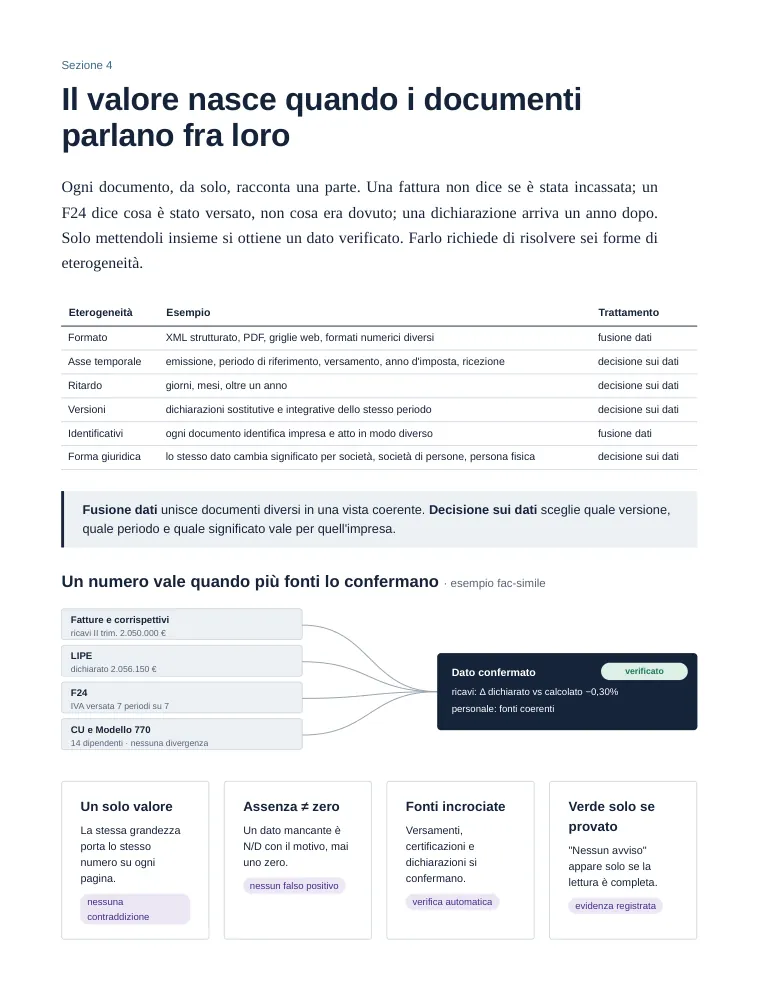
Sample company · illustrative data
How you receive it
One engine, three ways to receive it
Report per position
The credit report on a single company, on request, to attach to the credit file.
Portfolio monitoring
The same companies read every month, with an alert when a signal changes direction.
API and MCP · on request, large volumes
Metrics and signals inside your rating, decision and AI systems.
Read more
For credit institutions, credit insurers, financial analysts and large companies, from at least 100 reports a year. Configured on request, after a review of your portfolio. → Ask for an assessment
Pick a position from your portfolio. We show it to you read from the Cassetto Fiscale, page by page.
The demo is for lenders and analysts following at least a hundred companies. For a single company, activation is direct, from €29 a month.
The fiscal credit score is a complementary tool based on declared tax data. It is not a regulated credit rating within the meaning of Regulation (EC) No 1060/2009.
Questions
How early do tax data show that an Italian company is in difficulty?
On a real sample of companies, five to seven months before the Centrale Rischi. A company that stops paying VAT does so months before missing a loan instalment, and the gap shows in its F24 payments, its LIPE and its letters from the Agenzia long before the financial statements are filed.
Can we read an Italian company’s Cassetto Fiscale without its consent?
No. Access always comes from the company itself, through a read-only authorisation that it can revoke. FiscalPulse reads only the companies that have given that authorisation, and every report states the documents and the period it is built on. The rule is the same for a single position and for every company in a portfolio.
Is the fiscal credit score a regulated credit rating?
No. It is a complementary analytical tool based on declared tax data, with six dimensions and published weights that can be rebuilt by hand. It is not a regulated rating under Regulation (EC) No 1060/2009 and should not be the only criterion in a credit decision.
What can you see if the company files no financial statements?
Partnerships and micro companies often file none. The tax return still gives interest expense (line RF118) and equity and leverage (section RS), while monthly F24 payments, invoices and VAT returns give revenue, payment regularity and declared VAT arrears. Balance-sheet metrics that need filed accounts are marked as not assessable, with the reason.
How do we receive the data across a whole portfolio?
In three ways: a report per position, monthly monitoring of the companies you follow, or API and MCP access inside your own systems. API and MCP are configured on request for at least 100 reports a year, after a review of your portfolio.