
Credit analysis
The reading a lender makes of your Italian company, calculated every month on its declared data.
A tax score across six dimensions with published weights, the ratings the Agenzia delle Entrate has already given the company, VAT arrears, financial charges and equity read from the tax returns. Every month FiscalPulse also gives you the version to present to Italian banks, confidi (credit guarantee consortia) and leasing companies when you apply for credit.
€29 a month · no financial statements to attach · banks and confidi with a hundred companies or more: demo
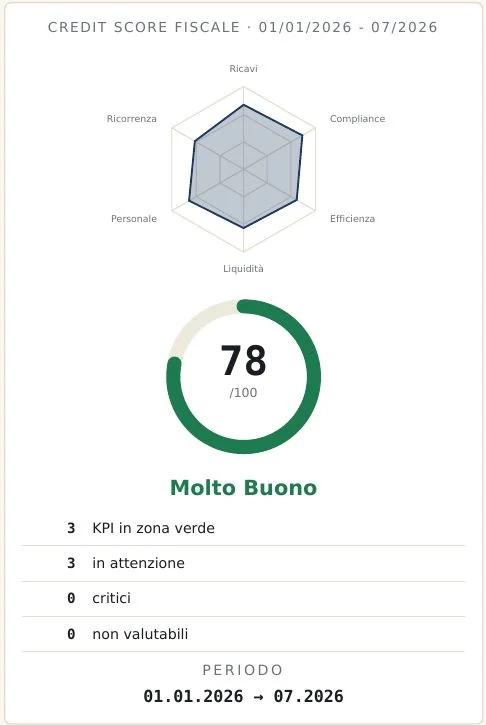
Sample company · illustrative data
How it works
How the reading is built
Sample company · illustrative data
01A score on six dimensions, with the weights on the page.
Revenue strength and tax compliance weigh 25% each, efficiency and liquidity 15%, workforce stability and recurring revenue 10%.
Read more
The score is adjusted for sector risk and can be rebuilt by hand, dimension by dimension.
ISA tax reliability 8.2
VIES status active
Sample company · illustrative data
02The ratings the Agenzia has already given.
The ISA score (the Agenzia’s own tax reliability index), the VIES status of the VAT number and the regularity of VAT and INPS social security payments already exist, and a lender can see them.
Read more
The report shows them next to the score, with their source.
Declared financial structure 2025
financial charges €6,200, equity €264,000
Sample company · illustrative data
03The financial structure read from the tax return.
Interest expense from line RF118, capital and reserves from section RS, VAT arrears from section VQ of the annual VAT return: figures declared to the Italian State, which describe debt even when the financial statements are old or do not exist.
04The version to present, updated to last month.
Every month, next to your own report, there is a version designed for whoever decides on credit, with the same numbers and the methodology printed in the appendix.
For your next credit application
What you bring to the bank, and what you know before you go in
Status count
3 green · 3 to watch · 0 critical
Sample company · illustrative data
You know what you are judged on, and what to improve
The tax score publishes the weight of each dimension and shows which ones need attention, so you know where to act before you apply.
Read more
In the sample, three of six need attention: operating efficiency, liquidity and recurring revenue.
Capacity to invest
+€5.3k/month, available +€4.2k/month, capex simulation
Sample company · illustrative data
How much you can invest without straining cash
Before signing for a machine or a vehicle you need to know whether the instalment holds.
Read more
The report estimates monthly self-financing, how much remains available after a reserve, the best months to invest and how much the VAT credit on the investment reduces the next VAT payments.
The report for the bank, with last month’s numbers
For a credit line, an Italian bank often relies on the last filed financial statements, which may be eighteen months old.
Read more
You arrive with last month’s numbers, the tax score and payment regularity already explained, so the application starts from data you have read yourself.
VAT arrears, seen and settled before the bank sees them
A VAT debt lives in the Agenzia’s systems for one or two years before a bank sees it, and by then it is too late to explain.
Read more
The report reads the arrears declared in section VQ and the recovery payments, so you settle them while it is still in your hands.
Leverage and financial charges, even without financial statements
Whoever assesses you estimates leverage with their own numbers.
Read more
The report calculates it from the interest expense and equity declared in the income tax return, and it also works for Italian partnerships, which do not file financial statements.
How much remains if the top customer leaves
A credit assessor asks how much revenue remains if the main customer stops buying.
Read more
The report answers in euros, with three scenarios: losing the main recurring customer, a quarter of recurring revenue, or all of it. In the sample, losing the top recurring customer takes 11.4% off revenue.
The fiscal credit score is a complementary tool based on declared tax data. It is not a regulated credit rating within the meaning of Regulation (EC) No 1060/2009.
The same reading, from both sides of the table
Foreign subsidiary manager
The numbers to show an Italian bank, ready every month.
→Group CFO with an Italian branch
Your Italian entity’s numbers, before the bank reads them.
→Founder of an Italian SRL
A credit file that grows with your history.
→Credit analysts
Fresh tax signals on every position; demo from a hundred companies.
→Questions
What does the FiscalPulse tax score measure?
Six dimensions calculated on the company’s tax data: revenue strength, regularity of tax payments, operating efficiency, liquidity, workforce stability and recurring revenue. The weights are printed in the report, the score is adjusted for sector risk and it can be rebuilt by hand.
Is the tax score a bank rating?
No. It is a complementary analytical tool based on declared tax data, and it is not a regulated credit rating within the meaning of Regulation (EC) No 1060/2009. It shows how a lender would read your Italian company; the credit decision stays with the bank or the confidi.
Can we use the report to apply for a loan backed by the Italian SME Guarantee Fund?
Yes, as a supporting document. Every month you have a version to present to banks, confidi and leasing companies, with numbers updated to the previous month and the methodology in the appendix. It sits alongside the documents the bank requests for the application, including one backed by the Fondo di Garanzia per le PMI, the state guarantee fund managed by Mediocredito Centrale.
Are financial statements needed to assess creditworthiness?
No. The report works on e-invoices, F24 tax payments, quarterly VAT returns and income tax returns, which arrive months before the financial statements. This is why it also works for Italian partnerships and for companies whose last financial statements are a year and a half old.
Can a bank or confidi use it across many companies?
Yes. For banks, confidi, leasing and factoring companies following a hundred companies or more, we prepare a demo on real positions from the portfolio, always with each company’s authorisation. For volumes from a hundred reports a year, access through API and MCP is also available on request.
Come to the bank’s table with numbers you have already read.
Every month you receive your own report and the version to present to lenders.