
How we read the numbers
The ERP records what the company does. The Cassetto Fiscale records what the Italian State has received.
They are two archives of the same company, kept by different people and updated at different times. Looking at them side by side is the simplest way to notice, in good time, a line that does not add up.
Sample company · illustrative data
Five different places, one archive already brought together
In any given week, a company’s numbers sit in five places: invoices in the ERP or accounting software, F24 payments (the single form for Italian taxes and contributions) in an email from the accountant’s office, the VAT return in a PDF, a letter from the Agenzia delle Entrate (the Italian Revenue Agency) in the PEC inbox, the company’s certified email, and a tax credit on a page of the Agenzia’s portal. Each tells part of the story, and putting them together takes time and someone who remembers to do it.
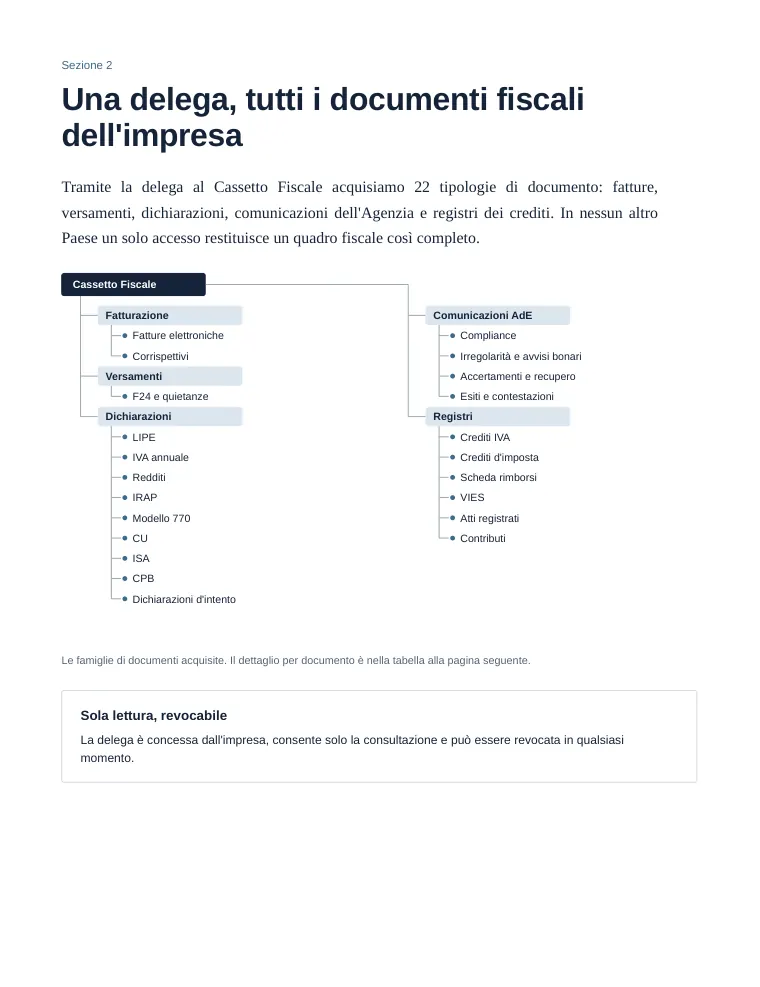
In the Cassetto Fiscale, the company’s tax drawer at the Agenzia, those documents are already in one place, because the State has received them all. The report reads them from there, twenty-two types in all, and gives them back as a single reading every month.
Sample company · illustrative data
Each archive has its own job
The ERP is the tool the company works with: jobs, orders, stock, customer due dates, bookkeeping. It records what the company has decided to record, when it records it.
The Cassetto Fiscale records what has reached the State. Since 2019 every invoice between Italian businesses goes through one national system, SDI (the e-invoicing exchange), before it is valid. Every F24 appears with its receipt and every return with its filing date. The two archives complete each other.
Where the two archives meet
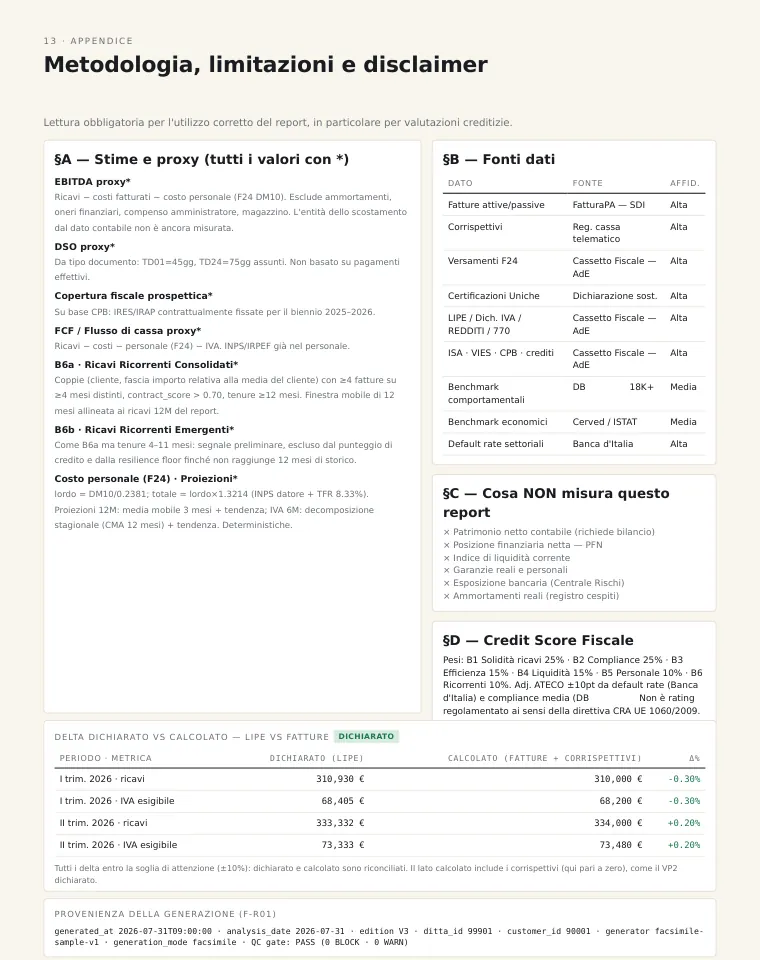
The clearest meeting point is revenue. In the sample company, invoices and electronic retail takings for the first quarter of 2026 add up to €310,000, while the LIPE (the quarterly VAT return) declares taxable sales of €310,930: a gap of 0.30%. In the second quarter the calculated figure is €334,000 and the declared one €333,332, a gap of 0.20% the other way.
The report runs this comparison on revenue and output VAT, for every period and every company. Within a 10% gap it treats the two sides as reconciled. Beyond that, it flags the gap.
Sample company · illustrative data
Q1 2026 · declared in LIPE €310,930 · calculated from invoices and takings €310,000 · −0.30% · Q2 2026 · €333,332 against €334,000 · +0.20%
When a line does not add up
Sometimes the two archives tell different stories. A VAT return declares VAT that the F24 payments do not show in full, or a credit used to offset other taxes does not match the one the Agenzia has on record.
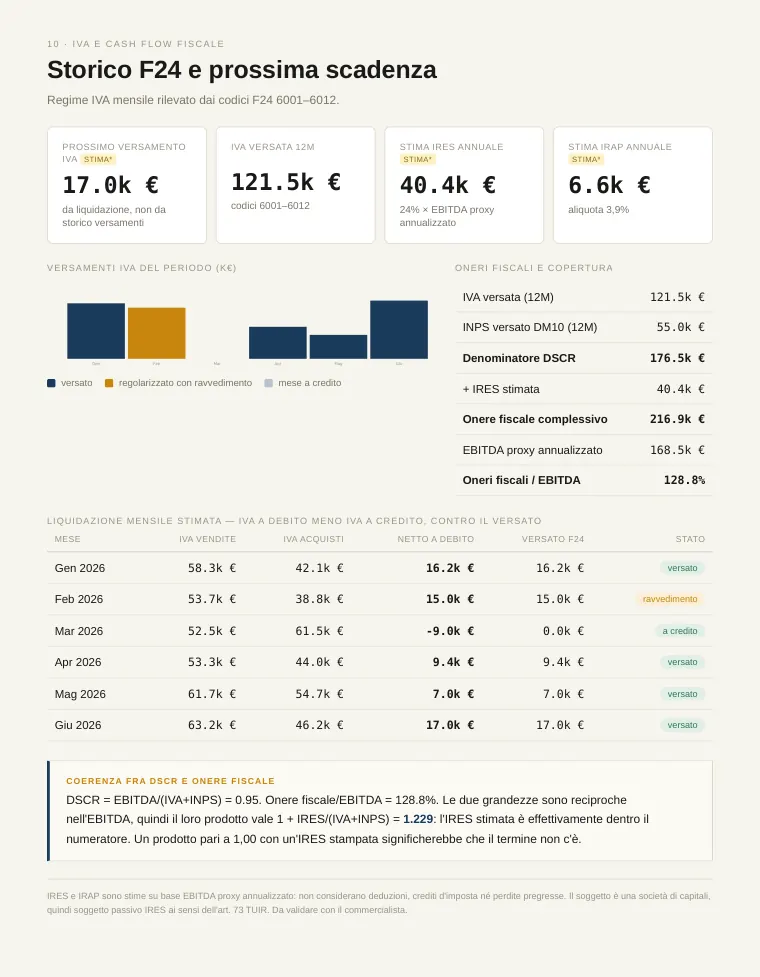
In these cases the report shows what was due, what was paid and the difference, period by period. For a sample wholesale company, the monthly table marks February as settled through ravvedimento (voluntary correction with a reduced penalty) and March as a credit month, next to the months paid as normal.
Sample company · illustrative data
Estimated monthly VAT against payments · January paid €16.2k · February €15.0k, settled through ravvedimento · March in credit
On the report page
The table that puts declared next to calculated
In the appendix of every report, the “Declared vs calculated delta” table compares, for each quarter, the revenue and output VAT declared in the periodic VAT return with the figures rebuilt from invoices and electronic takings. Each row shows the gap as a percentage and a note saying whether the two sides are reconciled.
You already have the data. The State has already put it together.
Sample company · illustrative data
Questions
Does the report replace our ERP?
No, it works alongside it. The ERP remains the tool the company works and records with. The report reads what the State has received and compares it with the returns: on one page you see where the figures agree and where something needs checking.
Why can revenue in the ERP differ from revenue in the Cassetto Fiscale?
Because of booking times, deferred invoices, credit notes, electronic retail takings and amended returns. Small gaps are normal. The report measures them quarter by quarter, for revenue and for output VAT, and flags those above the 10% attention threshold, next to the documents they come from.
Do we need to connect our ERP to the report?
No. The report reads only the Cassetto Fiscale, with the company’s credentials or through a partner accountant appointed as intermediary. No integrations, exports or installations are needed, and the ERP stays as it is. Access is read-only and you can revoke it whenever you want, in a minute.
Does it work with any accounting software?
Yes, because the report does not connect to the accounting software. Whatever system the company uses, e-invoices, F24 payments and tax returns still reach the Cassetto Fiscale, and that is where the report reads from. Changing software does not break the history either, which stays in the Cassetto.
What happens if declared and calculated figures differ?
The report shows the gap as a percentage for every quarter and measure. Within 10% the two sides count as reconciled. Beyond that, the gap is flagged on the page together with the documents it comes from, so you can see straight away where to look.
If you would like to see your company’s Cassetto Fiscale next to the ERP you use today, you can start the report without changing anything you already have.