
For groups with an Italian subsidiary
Italy’s Revenue Agency reads your subsidiary every month. Now headquarters can too.
FiscalPulse turns your subsidiary’s Cassetto Fiscale, its tax drawer at the Agenzia delle Entrate, into one monthly report in English.
€29 a month · nothing to install · read-only access you can revoke

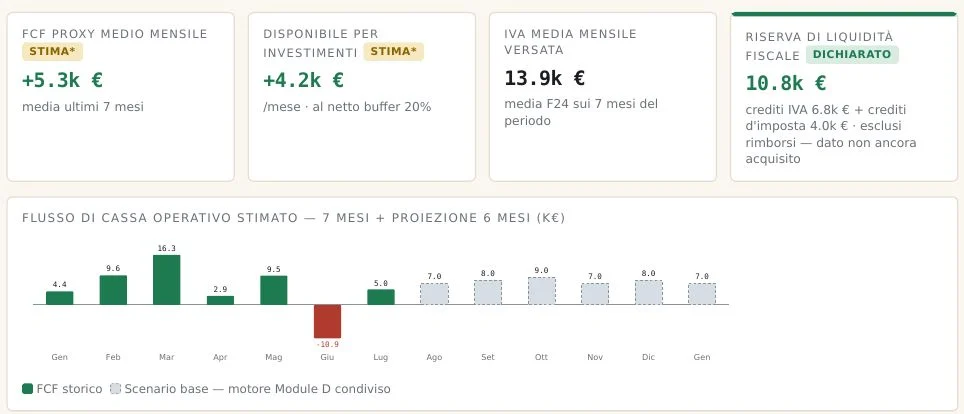 Sample company · illustrative data
2.4 million
compliance letters to companies in 2026, all in Italian
22
tax document types read from one access
20,000+
Italian companies read by our engine
Every month, for headquarters
Numbers that usually wait for the quarterly review
Tax credits and refunds held up
Recognised credits and refunds can sit unused for a long time.
Read more
These are VAT credits, tax credits and refunds tied to your subsidiary’s VAT number, left in the Cassetto Fiscale simply because nobody has them all in one view. The report adds them up as a fiscal liquidity reserve and flags the ones withheld or offset against an old debt.
Agenzia letters, explained in English
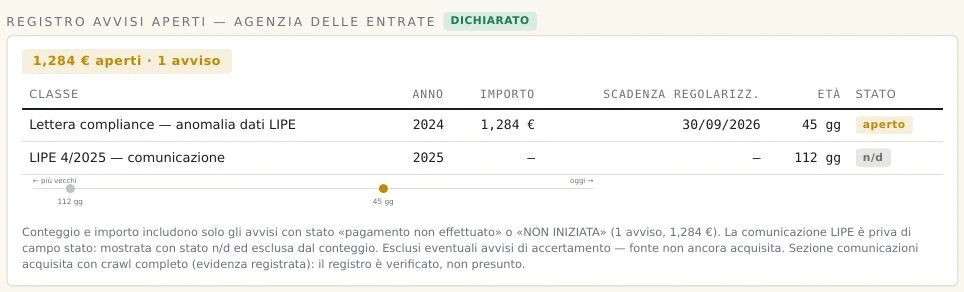
Agenzia letters can arrive on any day, in Italian.
Read more
They appear in the Cassetto Fiscale and may reach the people involved at different times, so each one now reaches you by email with the Italian original attached and the amount, the reason and the deadline explained in English. For an avviso bonario (the Agenzia’s notice of irregularity), paying within 60 days cuts the penalty to one third. Found late, it carries the full penalty.
What the subsidiary will owe, and when
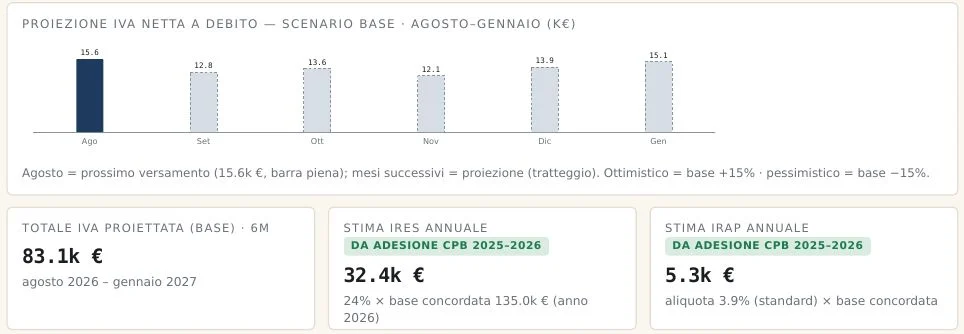
Everything the entity will pay in the next six months.
Read more
The report projects it from the payments made: the next VAT payment, payroll contributions due, and instalments of IRES, the 24% corporate income tax, and IRAP, the regional tax at a standard 3.9%. The cash call to headquarters never arrives as a surprise.
One monthly statement for headquarters
The parent company asks for standard monthly reporting.
Read more
The Italian entity often has no finance function of its own. The report arrives on the same dates every month, provisional on the 3rd and final on the 18th, and opens with three things that work and three to watch.
Customers cooling off, months early
The customer buying less, spotted months before annual revenue shows it.
Read more
It reads this from the e-invoice flow, so you hear about it while there is still time to act, without waiting for the local sales report.
Margins against Italian peers
Your subsidiary ranked against Italian peers of the same activity code.
Read more
Margin, VAT compliance, customer concentration and productivity are shown as percentiles, so you see whether the subsidiary performs like its Italian peers, using the same yardstick the local market uses.
VIES status and cross-border flows
Whether your subsidiary’s VAT number is active in VIES.
Read more
VIES is the EU register that confirms a VAT number can trade within the Union, and the report also totals its purchases from abroad by type, as Italian e-invoicing records them: services bought from abroad and goods bought from other EU countries.
Proof for your director in Italy
Italian law makes the appointed director personally responsible for spotting trouble early.
Read more
A group that looks at its Italian figures once a year leaves that person exposed. Every monthly report is archived as it was generated, so the director can show what was monitored and when.
Your Italian subsidiary, seen from headquarters
Paolo, the founder, shows what headquarters sees every month.
Your accountant in Italy keeps doing their job.
The report sits alongside their work.
Read more
If you like, it reaches them in copy, and headquarters, the local team and the accountant then work from one document, and everyone hears about a letter from the Agenzia on the day it arrives.
Italian tax, in plain English
Five words your Italian team uses
Since 2019 every invoice between Italian businesses passes through one national system.
- Cassetto Fiscale
The company’s tax drawer at the Agenzia.
Read more
Invoices, payments, returns, letters and credit registers sit there in one place.
- Agenzia delle Entrate
Italy’s Revenue Agency.
Read more
It cross-checks data with automated systems and writes to the company when something does not match.
- SDI
The national e-invoice exchange.
Read more
Every Italian e-invoice passes through it, and an invoice it rejects does not legally exist.
- F24
The single form for paying taxes and contributions.
Read more
Its payment codes change over the years, so old payments need careful reading.
- LIPE
The quarterly VAT return.
Read more
It is filed with the Agenzia, and when the VAT declared in it and the VAT paid do not match, a letter follows.
Getting started
Set up in about half an hour, then it runs on its own
- 01
You give us access to the Cassetto Fiscale.
The company’s Entratel or Fisconline credentials are enough: these are the logins an Italian company uses with the Agenzia delle Entrate.
Read more
If you do not have them, we request them together through the company’s PEC, its certified email address, and they arrive in four to seven days. You can also appoint one of our partner accountants in Italy for read-only access.
- 02
We read the full history.
Invoices, F24 payments, LIPE, tax returns, letters from the Agenzia and credit registers: twenty-two document types, joined into a single reading.
- 03
You receive the report every month, in English.
A provisional version on the 3rd and the final one on the 18th, archived and ready to download.
Read more
You also get an email every time the Agenzia writes to the company.
Your accountant in Italy keeps doing their job. If you like, they receive the report in copy.
€29 a month per Italian company, with the company’s own credentials
for companies with up to 2,000 invoices a year · cancel whenever you like
Cancel whenever you like, with no penalty. The yearly plan is paid in one instalment.
- Full monthly report, provisional on the 3rd and final on the 18th
- An email for every letter from the Agenzia, with the original attached and explained in English
- A reminder before every deadline
- Alerts on out-of-scale invoices and on customers who are buying less
- A version of the report to present to Italian banks and confidi (credit guarantee consortia)
- Archive of every past report, always available to download
By subscribing you accept the Terms of Service.
A hundred companies or more. Banks, leasing and factoring companies, credit guarantee consortia, networks and groups that follow at least a hundred Italian companies: we show you the engine in a demo on real positions from your portfolio.
An Italian company spends between €5,000 and €50,000 a year on its accountant, admin staff and software to produce the data that lands in the Cassetto Fiscale. For €29 a month, that data works for you too.
Questions
What is the Cassetto Fiscale of an Italian subsidiary?
It is the subsidiary’s online tax drawer at the Agenzia delle Entrate. Every e-invoice, F24 tax payment, VAT return, income tax return and letter from the Agenzia lands there. FiscalPulse reads it every month with read-only access and turns it into one report in English for headquarters.
Can headquarters receive the report in English?
Yes. The monthly report and every letter alert are written in English, with the Italian original attached to each letter. Italian terms such as F24, LIPE or IRES are explained once, so a controller abroad can read the numbers without asking the local team to translate.
What is the corporate tax rate in Italy?
IRES, the corporate income tax, is 24%. IRAP, the regional tax on productive activity, has a standard rate of 3.9% that varies by region. The report projects both for your subsidiary, using the income agreed with the Agenzia when the company has joined the two-year advance agreement on taxable income (concordato preventivo biennale).
What happens if an avviso bonario is not paid within 60 days?
The subsidiary loses the reduction of the penalty to one third, and the amount goes to collection with the full penalty and interest. Paying in instalments keeps the reduction, as long as the first instalment is paid within the 60 days. The report puts the deadline on page one and sends a reminder before it passes, straight to headquarters.
Do we need to connect a bank account or our ERP?
No. The subsidiary’s Entratel or Fisconline credentials are enough, or a partner accountant in Italy appointed for read-only access. There is nothing to install and no account to connect. Access is read-only, we never write to the Cassetto Fiscale, and the subsidiary can revoke it at any time, in a minute.