
You sell at 4% or 10% VAT and buy at 22%. The credit grows every month, and the report shows how to recover it.
FiscalPulse reads your Cassetto Fiscale monthly: VAT credit and refunds, tax credits, costs against peers, supermarket customers.
€29 a month · no installation · read-only, revocable
 Sample company · illustrative data
4% and 10%
Italy’s reduced VAT rates for many foods and medicines.
Read more
Packaging, energy, maintenance and services are almost always bought at 22%.
Source: DPR 633/1972, Table A, parts II and III
+10%
The margin that decides an annual VAT refund.
Read more
A credit can be refunded if the average VAT rate on purchases is higher than the average rate on sales increased by 10%, with a credit above €2,582.28. Depreciable assets are left out of the calculation.
Source: DPR 633/1972, art. 30 c.3 lett. a; EC News, 2018
30 and 60 days
Maximum payment terms for food and agricultural products in Italy.
Read more
They are 30 days for perishables and 60 for everything else, counted from delivery.
Source: D.Lgs. 198/2021; EC News, December 2021
In the report
VAT, credits and costs
Reduced-rate VAT credit, recovered
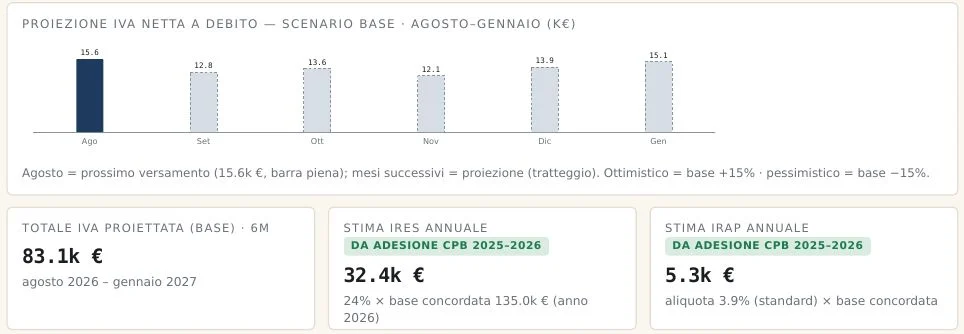
Reduced-rate sellers often pay more VAT than they collect.
Read more
A maker of pasta, milk or medicines collects VAT at 4% or 10% and pays it at 22% on packaging, energy and maintenance, so the credit grows even when business is good. The report puts input and output VAT side by side month by month, follows the annual VAT refund from claim to payment and tells you if it stalls.
Credits on lines, R&D and training
Industry 4.0 and R&D credits often sit unused.
Read more
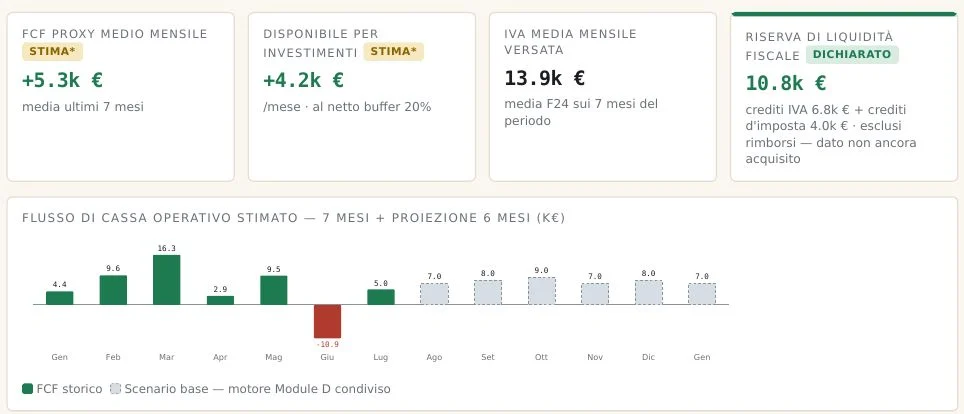
They are recorded in the Cassetto Fiscale: Industry 4.0 credits on plant and production lines and the research and development credit. The report adds them up in a fiscal liquidity reserve, checks the amount used against the credit column of your F24 payments (the Italian tax payment form) and tells you when a credit becomes usable.
Share of spend by category
metal fasteners 21.4%, steel tubes 18.5%
Margin after payroll 5.4% against a sector median of 8.1%
Sample company · illustrative data
Materials, packaging, energy against peers
Spending by category, compared with your peers.
Read more
The report separates fixed from variable costs and compares your margin with companies under the same ATECO code, the Italian business activity code, always by broad category and never by individual supplier. If one item is above your peers, you know where to start.
The VAT settlement, before the 16th
The next VAT payment, estimated from the settlement.
Read more
It is compared with the amount paid in the F24.
Collection, payment and cash cycle
When you sell to large retailers, the timing gap matters.
Read more
You often buy from smaller suppliers. The report estimates both and works out your cash conversion cycle.
Your top customer’s weight
The largest customer’s share, month by month.
Read more
You also see recurring revenue and the revenue that remains if the main recurring customer leaves.
IRES and IRAP without surprises
IRES and IRAP are estimated every month.
Read more
IRES is corporate income tax and IRAP the regional tax on productive activities. Declared figures replace the estimates as soon as they exist, so you know how much to set aside before the payments on account.
Noticing in time, and showing it
Directors can answer with personal assets for missed signs of financial difficulty.
Read more
Every month the report shows the early-warning indicators and archives the edition as it was generated.
Giulia shows what is inside and what reaches you every month.
At reduced VAT rates, an average decides the refund.
Two average VAT rates are compared.
Read more
They are the one on purchases and the one on sales, increased by 10%. If the first is higher, and the credit exceeds €2,582.28, the credit can be claimed back with the annual VAT return or even quarter by quarter. Machinery and other depreciable assets stay out of the calculation. The report shows the VAT on sales and on purchases every month, so you know before year end whether you are heading towards a credit to claim back or to offset.
Source: DPR 633/1972, art. 30 c.3 lett. a and art. 38-bis c.2; EC News, 2018
Who it is for, by ATECO code
- Food and beveragesATECO 10, 11
- Plastics in primary formsATECO 20.16
- Cosmetics and toiletriesATECO 20.42
- Pharmaceutical preparationsATECO 21.20
- Rubber and plastic productsATECO 22.2
- Measuring and control instrumentsATECO 26.51
- Valves, taps and refrigeration equipmentATECO 28.14, 28.25
- Motor vehicle partsATECO 29.32
Getting started
Set up in about half an hour, then it runs on its own
- 01
You give us access to the Cassetto Fiscale.
The company’s Entratel or Fisconline credentials are enough: these are the logins an Italian company uses with the Agenzia delle Entrate.
Read more
If you do not have them, we request them together through the company’s PEC, its certified email address, and they arrive in four to seven days. You can also appoint one of our partner accountants in Italy for read-only access.
- 02
We read the full history.
Invoices, F24 payments, LIPE, tax returns, letters from the Agenzia and credit registers: twenty-two document types, joined into a single reading.
- 03
You receive the report every month, in English.
A provisional version on the 3rd and the final one on the 18th, archived and ready to download.
Read more
You also get an email every time the Agenzia writes to the company.
Your accountant in Italy keeps doing their job. If you like, they receive the report in copy.
€29 a month per Italian company, with the company’s own credentials
for companies with up to 2,000 invoices a year · cancel whenever you like
Cancel whenever you like, with no penalty. The yearly plan is paid in one instalment.
- Full monthly report, provisional on the 3rd and final on the 18th
- An email for every letter from the Agenzia, with the original attached and explained in English
- A reminder before every deadline
- Alerts on out-of-scale invoices and on customers who are buying less
- A version of the report to present to Italian banks and confidi (credit guarantee consortia)
- Archive of every past report, always available to download
By subscribing you accept the Terms of Service.
A hundred companies or more. Banks, leasing and factoring companies, credit guarantee consortia, networks and groups that follow at least a hundred Italian companies: we show you the engine in a demo on real positions from your portfolio.
An Italian company spends between €5,000 and €50,000 a year on its accountant, admin staff and software to produce the data that lands in the Cassetto Fiscale. For €29 a month, that data works for you too.
Questions
Why are food companies often in VAT credit?
Because it sells many products at 4% or 10% VAT and buys packaging, energy and services at 22%. At month end the VAT paid to suppliers exceeds the VAT collected from customers, and the credit builds up. Every month the report shows input and output VAT, the credit built up and the part already used in F24 payments.
Source: DPR 633/1972, Table A
How is an annual VAT refund claimed?
Through the annual VAT return. A claim is possible when the average rate on purchases exceeds the rate on sales increased by 10% and the credit exceeds €2,582.28. Above certain amounts a compliance certification or a guarantee is needed, and your accountant checks the thresholds. The report follows the refund from claim to payment and tells you if it stalls.
Source: DPR 633/1972, art. 30 c.3 lett. a; EC News, 2018
Does it find unused Industry 4.0 and R&D credits?
Yes. It reads the tax credit register in the Cassetto Fiscale, adds the credits to your VAT credit in a fiscal liquidity reserve and checks the amount used against the credit column of your F24 payments. When a credit becomes usable you get an email, so it does not sit idle for years.
Which payment terms apply to supermarket chains?
For food products the maximum is 30 days for perishables and 60 for everything else. The terms run from delivery or from when the price is set. The report estimates collection and payment times from your invoices and the resulting cash cycle, and flags the customer who is ordering less.
Source: D.Lgs. 198/2021; EC News, December 2021
Can I compare costs with similar companies?
Yes, by supplier category. The report compares your share of spend by category with companies of the same sector and size, with at least thirty peers, and never by individual supplier name. You also see your margin before and after payroll against the median for your ATECO code.
Does it estimate what to set aside for IRES and IRAP?
Yes. It estimates the year’s tax, separates what you have already paid by F24 from what will fall due, and uses the declared figures as soon as they exist. You know before June and November how much cash to keep for the balance and payments on account, even in months when VAT is in credit.