
For curatori, liquidators and other appointed professionals
The company’s tax history, read from its Cassetto Fiscale into a single file.
When a curatore (the court-appointed insolvency practitioner) or a company’s liquidator takes on a mandate, the company’s tax documents are often scattered, incomplete or in different hands. The Cassetto Fiscale, the company’s tax drawer at the Agenzia delle Entrate (the Italian Revenue Agency), keeps them in one place. FiscalPulse reads invoices, F24 payments (the single form for Italian taxes and contributions), tax returns, letters from the Agenzia and credit registers and puts them in order in a report, with the document and year next to every number, updated every month for as long as the mandate needs it.
€29 a month per company · read-only access · cancel when the mandate ends
 Sample company · illustrative data
Seven readings for whoever has to reconstruct the picture
Recoverable credits and tax debts, document by document
Tax credits and refunds still recoverable
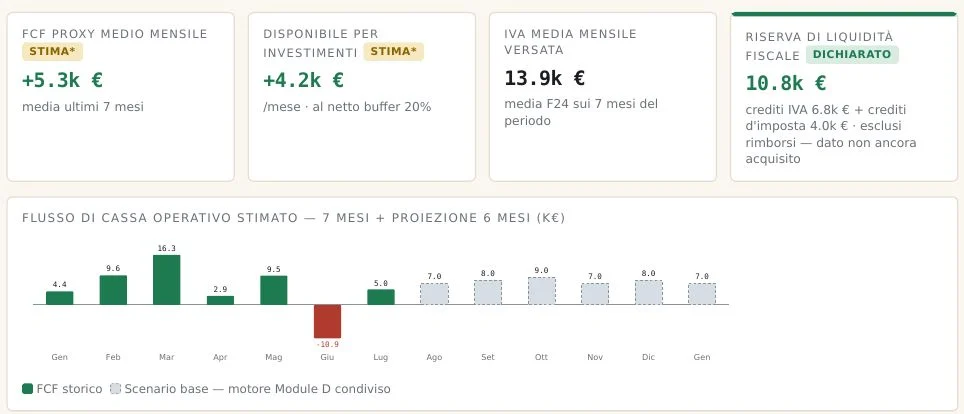
VAT credits, tax credits and refunds already recognised to the company are added up into one reserve, showing which ones are withheld, blocked by an administrative hold (fermo amministrativo) or offset against a debt.
Read more
It is an asset the accounting records often do not separate and that the Cassetto Fiscale records item by item.
Sample company · illustrative data
Updated every month, for as long as needed
During the procedure, letters, outcomes and payments keep arriving in the Cassetto Fiscale.
Read more
The report is updated every month, with a final version on the 18th archived exactly as it was generated, and emails you every time the Agenzia writes to the company.
The tax history in a single reading
Invoices issued and received, electronic receipts, F24 payments with their receipts, LIPE quarterly VAT returns, annual VAT and income tax returns, the 770 withholding return and CU employee certificates: twenty-two document types read with a single access and joined in the same report.
Read more
In a liquidazione giudiziale, the judicial liquidation that replaced bankruptcy (fallimento) in Italy, the curatore starts from a base already in order, with sources stated.
Customers, suppliers and revenue month by month
The main customers and suppliers by amount invoiced, how concentrated they are and the monthly revenue trend, rebuilt from e-invoices.
Read more
You see when activity slowed and with which counterparties, a starting point for checks on existing contracts.
Tax debts, instalment plans and pending acts
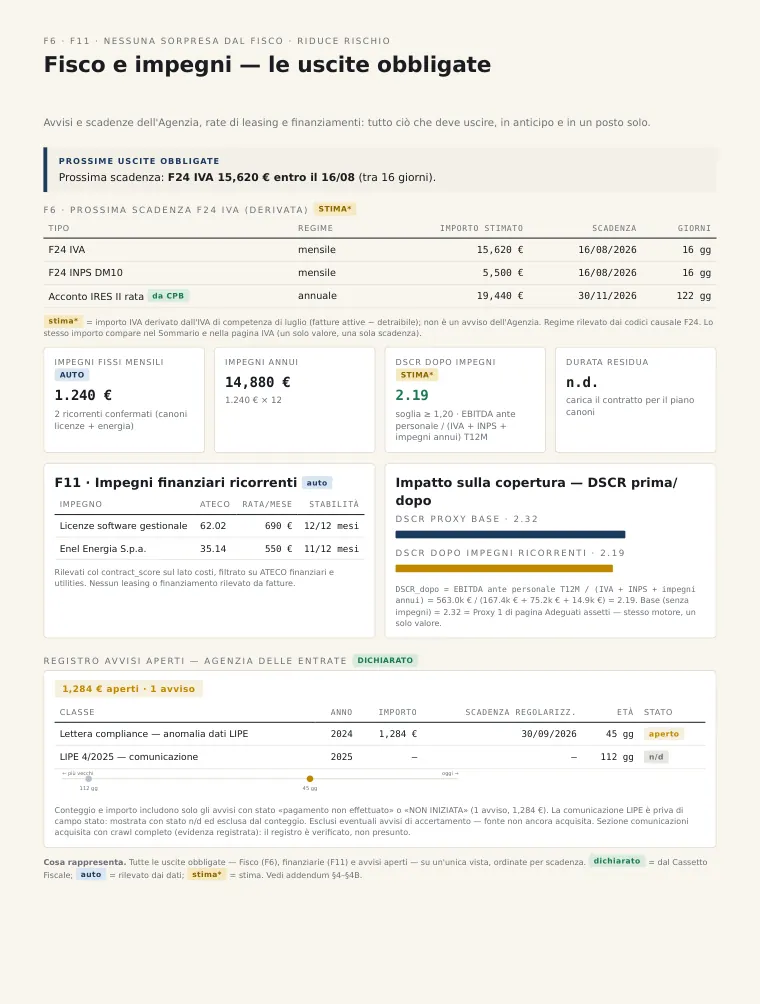
Open notices and notices of irregularity are listed with class, year, amount, deadline and age, and instalment plans with the instalments left, read from the F24 forms.
Read more
For the Agenzia’s most recent acts the report gives the status of the procedure and the total with penalties and interest, and the declared VAT arrears from section VQ of the annual VAT return appear with the recovery payments.
When payments started to go missing
Period by period the report shows VAT and social security payments, late payments, ravvedimenti (voluntary corrections with a reduced penalty) and instalment plans, and reads from the front page of each tax return the role code of the person who signed it.
Read more
These help rebuild the timeline, and they come from State documents.
Every number with the document and year it comes from
Where a figure was declared to the State, the report uses it in place of an estimate and marks it as declared, naming the document and year.
Read more
Where an estimate remains, it is marked as one. The original document stays in the Cassetto Fiscale, and that is the one to cite in court filings.
A tool for analysis, built on the State’s own documents.
The report puts in order and measures what the company sent to the Agenzia delle Entrate and what the Agenzia sent to the company.
Read more
Assessments, decisions on the procedure and filings stay with the appointed professional. The report brings the tax facts in order, each with its source, and keeps them up to date month after month.
It starts with access to the company’s Cassetto Fiscale
The report is activated with the company’s Entratel or Fisconline credentials, by whoever is entitled to use them, or through one of our partner accountants appointed for read-only access. Access is read-only: we never write to the Cassetto Fiscale. Activation takes about half an hour and the first reading covers the whole history available.
Questions
How do you reconstruct the tax position of an Italian company in liquidation?
Start from its Cassetto Fiscale, which keeps invoices, F24 payments, tax returns, letters from the Agenzia and credit registers. FiscalPulse reads them with a single access and puts them in a report with tax debts, instalment plans, recoverable credits, and main customers and suppliers, each number with its source.
Does the report count as a certification or an expert opinion?
No, it is a tool for analysis and control. Every number points to the Cassetto Fiscale document it comes from, and that document remains the source to cite in court filings. Assessments and conclusions stay with the appointed professional, who starts from a base already read and put in order.
Who activates access to the company’s Cassetto Fiscale?
Whoever is entitled to use the company’s Entratel or Fisconline credentials, or a partner accountant appointed for read-only access. Access can be revoked, and the report goes to the people you name: the curatore, the company’s liquidator or the professionals working on the mandate.
How much does it cost and for how long is it used?
€29 a month, or €289 a year, for a company with up to 2,000 invoices a year. The report is updated every month for the whole length of the mandate, with a final version archived on the 18th, and you cancel it when it is no longer needed.
What can you see of the company’s debts to the Italian tax authority?
Open notices, instalment plans and declared VAT arrears, each with amount and deadline. For each notice the report also gives its age, for instalment plans the instalments left read from the F24 forms, and for the most recent acts the status with penalties and interest. Everything comes from Agenzia documents in the company’s Cassetto Fiscale.