
For holding companies and groups with several Italian companies
Every company in the group, read each month from its own Cassetto Fiscale and set side by side.
FiscalPulse reads the Cassetto Fiscale of each subsidiary, its tax drawer at the Agenzia delle Entrate (the Italian Revenue Agency), and gives the people running the group the same report for every company: idle credits, letters from the Agenzia, payments due, customers and tax score. You compare subsidiaries on the documents the State has already received from each of them.
€29 a month per company · each company grants its own read-only access · 100 companies or more: demo
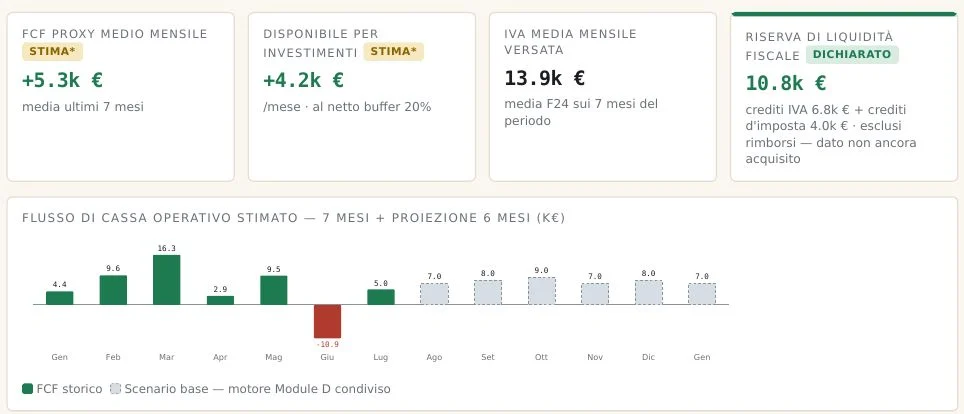 Sample company · illustrative data
Seven readings for whoever runs several companies
Tax cash held in each subsidiary, and the oversight every board asks for
Tax cash sitting idle in each subsidiary
A VAT credit, a tax credit or a refund often stays in the company that earned it, while another company in the group asks its bank for credit.
Read more
Each report adds up its company’s fiscal liquidity reserve and flags refunds withheld or offset against a debt still open. Read side by side, the reports tell you how much tax cash is idle across the group.
The 16th of the month, company by company
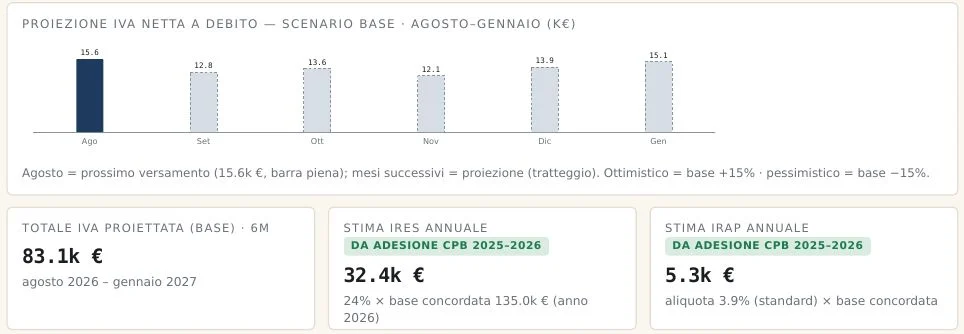
The next VAT payment, social security contributions, tax prepayments and running instalment plans for each subsidiary, each with its due date.
Read more
Group treasury knows ahead of time which company has to pay how much, and where to move cash before the deadline.
Margins and costs, company by company, against peers
Each subsidiary is compared with companies under the same ATECO code (the Italian business activity classification) on margin, payroll cost as a share of revenue and customer concentration.
Read more
Spending by supplier category shows where to look, always in broad categories and never supplier by supplier. You see which company spends more than its peers before the group accounts say so.
Letters to every subsidiary, sent to the right people
When the Agenzia writes to a group company, an email goes out to the people you name as soon as the letter appears in the Cassetto Fiscale, with a copy, the amount and the date to settle by.
Read more
A periodic summary collects the notices received, so letters to the smallest company land on the same list. Paid within 60 days, an avviso bonario (the Agenzia’s notice of irregularity) carries a third of the penalty.
Customers, concentration and dealings inside the group
The report spots the customer who is buying less, months before the drop shows in the year’s revenue, and measures how much each company depends on its top customers.
Read more
When a subsidiary works mainly for another group company, the concentration figure makes that plain, together with the revenue that would remain if the relationship changed.
A tax score for each company, to decide where cash and credit go
A score on six dimensions, with published weights and a formula you can rebuild by hand, calculated the same way for every subsidiary.
Read more
It tells you which company presents better to a bank and which needs support, before its lenders decide for you.
Documented oversight for every board of directors
Each Italian subsidiary has its own board and its own duty to keep adequate organisational arrangements (adeguati assetti) under article 2086 of the Civil Code.
Read more
For each one, the report keeps a monthly register of early-warning indicators and warns you in good time if overdue VAT nears €20,000, the level above which the Agenzia must notify that company and its statutory auditors, if it has them. Every report stays archived exactly as it was generated.
The fiscal credit score is a complementary tool based on declared tax data. It is not a regulated credit rating within the meaning of Regulation (EC) No 1060/2009.
Giulia shows what is inside and what reaches you every month.
Different accounting systems, different accountants, the same Cassetto Fiscale.
In a group each company often has its own accounting software, its own accountant and its own way of closing the month, and putting the numbers together takes days.
Read more
The Cassetto Fiscale of every Italian company has the same format: invoices, F24 payments (the single form for Italian taxes and contributions), returns and letters the State has already received. The report starts there, so every company is read the same way, on the same documents.
Each company activates its own access in half an hour
Each subsidiary grants access to its Cassetto Fiscale with its Entratel or Fisconline credentials, or through one of our partner accountants appointed for read-only access. The authorisations held by the firms that already look after the companies stay where they are. The report arrives on the 3rd as a provisional version and on the 18th as the final one, sent to the people you name for each company and, if you like, to the accountant.
Groups with a hundred companies or more: we show you the engine in a demo on real group companies.
Companies with more than 2,000 invoices a year: a proposal sized on your volumes
Questions
How do you monitor the tax position of several Italian subsidiaries?
With a monthly report for each company, read from its Cassetto Fiscale and built on the same indicators. Credits, letters from the Agenzia, payments, customers and tax score take the same form for every subsidiary, so the comparison runs on the same documents and the holding company sees at once where to step in.
Can the holding company activate the report for its subsidiaries?
Each company grants its own access, with its credentials or through a partner accountant appointed for the purpose. Once the report is active, it goes to the people at the holding company that the subsidiary names. Access is read-only and each company can revoke it whenever it wants.
How much does the report cost for a group of companies?
€29 a month, or €289 a year, for each company with up to 2,000 invoices a year. For groups with a hundred companies or more we prepare a demo on your positions and a proposal sized on volumes. Companies above 2,000 invoices a year receive a dedicated proposal.
Is the report useful to each subsidiary’s board?
Yes. Each report holds the early-warning indicators, the archived monthly register and the alert on the €20,000 overdue VAT threshold. It is periodic documentation that each company’s board can bring to its meetings and share with the collegio sindacale, the Italian board of statutory auditors.
Do the subsidiaries’ accountants have to change anything?
No. They carry on with the authorisations they already hold. If you wish, each one receives in copy the report of the company they look after, so the holding company and the different firms work from the same document, and when the Agenzia writes, everyone hears about it on the same day.