
All the company’s data in one place
The Italian State has already brought your company’s data together. The report gives it back to you in one reading.
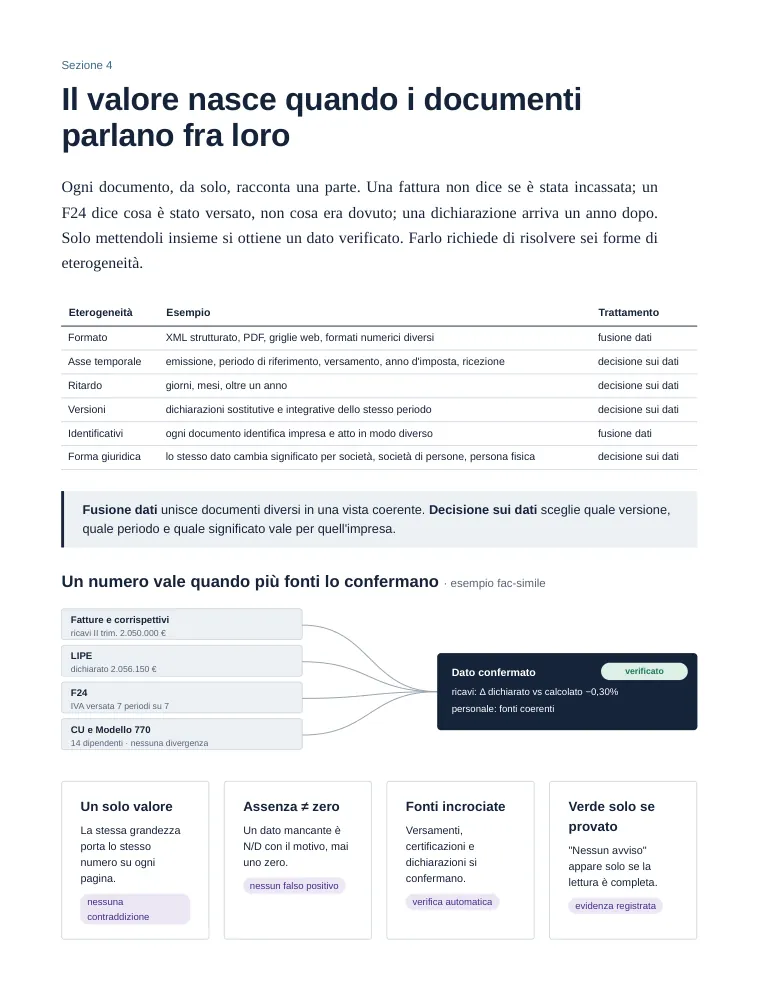
E-invoices, retail takings, F24 payments (the single form for Italian taxes and contributions), tax returns, employee income statements, letters and credit registers are spread between the local accounting system, the accountant’s office and the admin team. In the Cassetto Fiscale, the company’s tax drawer at the Agenzia delle Entrate, they already sit together. FiscalPulse reads them every month and cross-checks them: invoice revenue against the revenue declared in the VAT returns, payments against what was due.
€29 a month · no accounting system or bank account to connect · read-only access you can revoke at any time
Sample company · illustrative data
How it works
Twenty-two document types, one consistent view
Sample company · illustrative data
01You grant read-only access.
With the read-only access you grant, the report reads twenty-two document types in five families: invoicing, payments, returns, letters from the Agenzia and credit registers, including the refunds record and VIES status (the EU register of valid VAT numbers).
Sample company · illustrative data
02Each document read on its own calendar.
An invoice has an issue date, an F24 a payment date, a return a tax year, a letter a date of receipt.
Read more
The report places each document in the period it refers to and, when an amended or replacement return exists, uses the version that counts.
Next F24 VAT payment
€15,620
the same amount in the Summary and on the VAT page
Sample company · illustrative data
04One number for each figure.
The same figure carries the same number on every page of the report, and a missing figure appears as not available, with the reason, never as a zero.
03Documents confirm one another.
Quarterly VAT returns are checked against invoices and retail takings, employee income statements against the annual withholding return and the F24 payments, credits against offsets, letters against payments.
Read more
A number counts as confirmed when the sources agree. Where they differ, the page shows the gap and its size.
What you find in one reading
What you see when the documents sit together
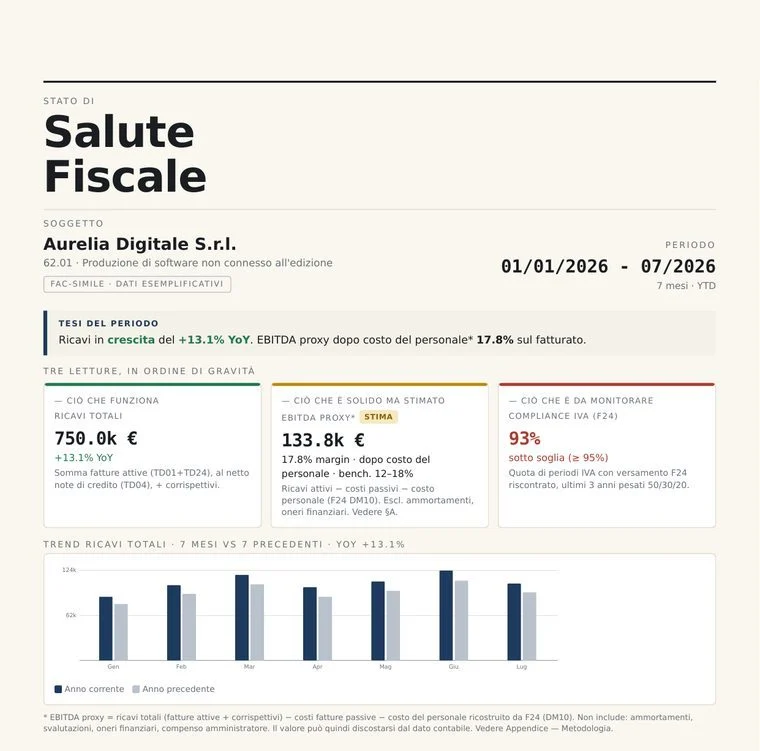
Revenue YTD €750.0k, +13.1%, split by document type
Sample company · illustrative data
Revenue month by month, without waiting for the financial statements
Financial statements describe the year long after it has ended.
Read more
Every month the report adds up invoices and retail takings, net of credit notes, and compares the total with what was declared in the quarterly VAT returns: you see how the Italian company is doing now, and by what margin of difference.
Revenue bridge €663.0k →
€750.0k
Sample company · illustrative data
Who arrived and who left
Growing revenue can hide lost customers, offset by new ones.
Read more
The report breaks the year down into revenue from new customers, revenue lost and the change in stable customers, and the bridge closes exactly on the total.
Supplier costs by category, cloud services 34.4% of spending
Sample company · illustrative data
Where the money goes, by category
Costs rise and it is not clear where.
Read more
The report reads every supplier invoice and groups spending by supplier category, always in broad categories and never judging an individual supplier, so you see at once which item weighs most.
One reading in place of five places
Invoices in the accounting system, F24 receipts in an email from the accountant, returns as PDFs, letters by certified email, credits in a tab of the Agenzia’s portal.
Read more
Every month the report brings them together on one page and explains them in English.
Staff costs read from three documents
Staff costs often become clear only after the fact, for example in December, when the thirteenth-month salary and its contributions fall due.
Read more
The report rebuilds them from the contributions paid every month through F24 and checks them against the Certificazioni Uniche (the annual income statements issued to employees) and the Modello 770 withholding return, two independent sources.
Credits and offsets that add up
A credit used to offset a payment in an F24 must match the one registered by the Agenzia, or sooner or later a letter arrives.
Read more
The report compares the credit register with the credits column of the F24 payments and adds up what remains into a fiscal liquidity reserve.
For whoever needs the whole picture
Foreign subsidiary manager
Your Italian entity in one monthly statement, in English.
→Group CFO with an Italian branch
What was declared, checked against the documents.
→Founder of an Italian SRL
Invoices, payments and returns, read together from month one.
→Credit analysts
Twenty-two document types behind every position.
→Questions
What documents does an Italian company’s Cassetto Fiscale contain?
It holds the company’s tax documents received by the Agenzia delle Entrate, gathered in one archive. These include e-invoices and retail takings, F24 payments with receipts, quarterly VAT returns, VAT, income tax and IRAP returns, the Modello 770 and employee income statements, letters from the Agenzia, credit registers, the refunds record, ISA, the two-year agreement and VIES status. FiscalPulse reads twenty-two document types and joins them into one monthly report.
How can I see an Italian company’s e-invoices?
Through the Agenzia’s “Fatture e Corrispettivi” portal, one document at a time. Since 2019 every invoice between Italian businesses passes through SDI, the national e-invoicing exchange. The report reads them all every month, adds them up by month, customer and supplier category, removes credit notes and compares the result with revenue declared in the VAT returns.
Does it work alongside our accounting system?
Yes. The report reads only the Cassetto Fiscale, so it sits next to any accounting system with nothing to install and no integration to maintain. The company’s Entratel or Fisconline credentials are enough, or a partner accountant in Italy appointed for read-only access. Authorisations your accountant already holds stay as they are.
Why join the documents instead of reading them one by one?
Because each one tells only part of the story. An invoice does not say whether it was collected, an F24 says what was paid without saying what was due, a tax return arrives a year later. Put together, they confirm a number or show where it does not add up, with the gap measured.
How often is the data updated?
Every month. The report comes out in a first version on the 3rd and a final version on the 18th, then stays archived. Invoices and F24 payments reach the Cassetto Fiscale within days, quarterly VAT returns after about two months, annual returns once a year: each figure comes in as soon as it is available.
Your Italian company’s data already exists. Read it all together.
The report arrives every month, provisional on the 3rd and final on the 18th, with each figure next to its source.