
Progress invoices are paid late. Their VAT is due on the 16th.
FiscalPulse reads your Cassetto Fiscale monthly: VAT credit, F24 due, tax letters, slow payers.
€29 a month · no installation · read-only, revocable
 Sample company · illustrative data
4 to 5 months
Typical payment time in Italian construction.
Read more
The Italian builders’ association reports it against the 30-day limit in the European Commission’s proposed regulation on late payments.
Source: ANCE, hearing on the proposed EU late payment regulation COM(2023) 533, November 2023
€2,582.28
Reverse-charge subcontractors can reclaim VAT credit above this.
Read more
It applies when the average VAT rate on their purchases is higher than the average rate on their sales increased by 10%.
Source: DPR 633/1972, art. 17 c.6 and art. 30 c.3 lett. a; Fiscomania, 2025; EC News, 2018
5 days
Deadline to send clients the crew’s withholding-tax F24 forms.
Read more
It runs from payment and applies to contracts above €200,000 that rely mainly on labour. A DURF certificate from the Agenzia, valid for four months, replaces them.
Source: D.Lgs. 241/1997, art. 17-bis; Agenzia delle Entrate decision of 6 February 2020; Ediltecnico, 2020
In the report
Numbers the site has no time for
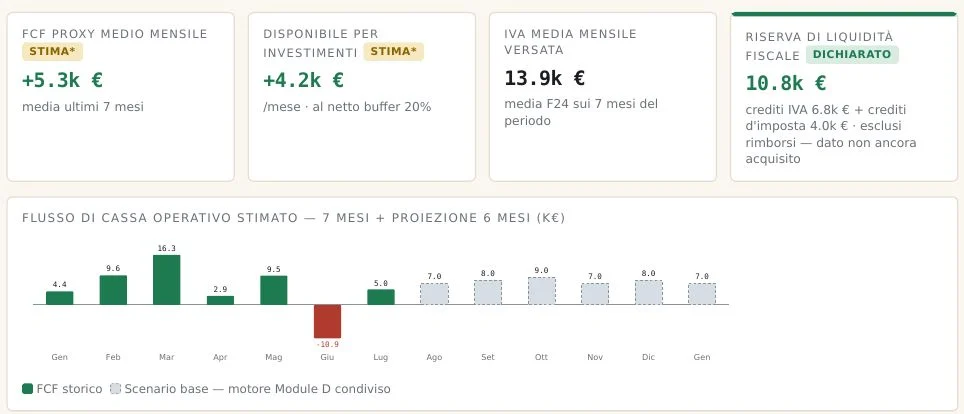
VAT credit back into cash
Under reverse charge, subcontractor invoices carry no VAT.
Read more
Under this Italian rule the buyer accounts for the VAT. Subcontractors still pay full VAT on materials and plant hire, and the credit grows every month. The report adds it to the tax credits on capital goods in one fiscal liquidity reserve and tells you when to offset it in the F24 (the Italian tax payment form) or claim a quarterly VAT refund.
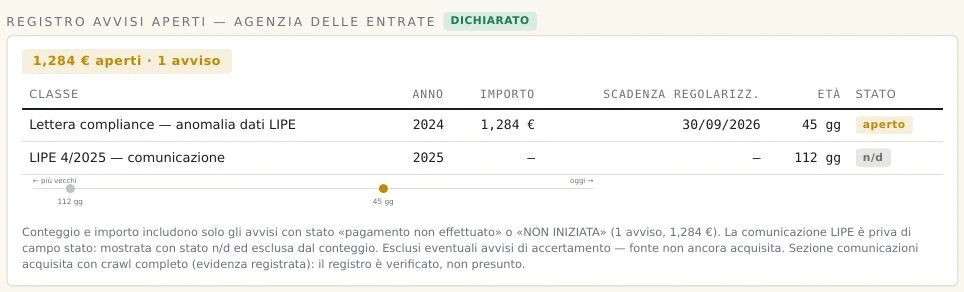
A third of the penalty within 60 days
Every open avviso bonario, with amount, reason and due date.
Read more
The avviso bonario is the Agenzia’s notice of irregularity, and settling it within 60 days cuts the penalty to a third. If you asked to pay one in instalments, the report reads from the F24 forms how many you have paid, how many remain and the balance, and reminds you before each due date.
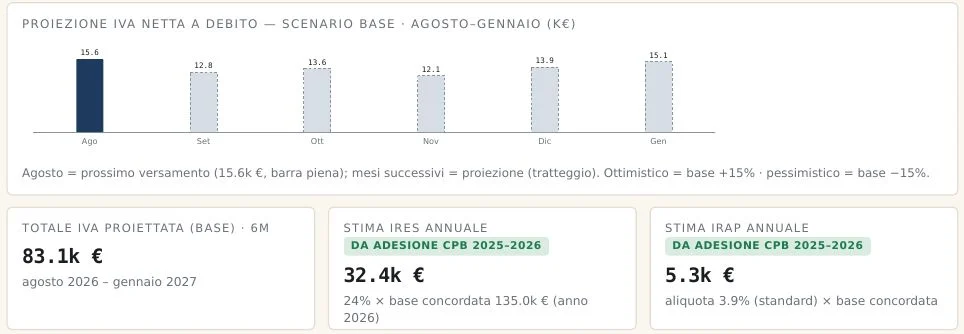
December’s SAL, January’s VAT
Contracts are billed by SAL, the progress invoice.
Read more
SAL stands for stato avanzamento lavori, the invoice for work completed. When you bill a private client, the VAT on it is due on the 16th of the following month, often before the client pays. The report estimates the next VAT payment and contributions every month and shows the months when cash runs short: in the sample, January goes negative because it absorbs the VAT on December’s SAL.
A report for the bank
A six-dimension tax score, ready when a bank asks.
Read more
Use it for a credit line or SAL advance. It shows the regularity of VAT and INPS (social security) payments and last month’s numbers, and serves a confidi (credit guarantee consortium) too.
The tax credit score is a complementary tool based on declared tax data. It is not a credit rating regulated under Regulation (EC) No 1060/2009.
Leased excavators and trucks
Leases and loans, read from recurring invoices.
Read more
You see their weight on cash after VAT and contributions.
Clients cutting back
You get an email when a client’s SAL shrinks.
Read more
It arrives before the gap reaches your bank account. In the sample, a general contractor cut its SAL by 39% in six months.
Crew withholding taxes in order
Withholding checked across CU, 770 and F24.
Read more
The report compares the ritenute (income tax withheld from wages) shown in the CU, the annual certificate given to each worker, with the 770 withholding return and the F24 payments. These are the same F24 forms a client asks for on labour-heavy contracts.
Proof you followed the accounts
Directors can answer with personal assets for missed warning signs.
Read more
Every report stays archived as it was generated, with that month’s early-warning indicators.
Giulia shows what is inside and what reaches you every month.
In subcontracting, the VAT credit stays with whoever does the work.
Subcontractors invoice without VAT, under reverse charge.
Read more
The invoice is marked “inversione contabile”. The main contractor completes the invoice and records the same VAT as both payable and deductible, so for him the effect is zero, and in the report those invoices (type TD16) sit on a separate line. The subcontractor pays VAT on materials, plant hire and supplies and collects it from nobody, so the credit builds up. It is recovered by offsetting it in the F24 or through a quarterly refund, and the report tells you every month how much has built up and how much you have already used.
TD16
construction subcontracts under reverse charge €3,710.0k year to date, separate line
Sample company · illustrative data
Source: DPR 633/1972, art. 17 c.6 lett. a and a-ter; Fiscomania, 2025
Who it is for, by ATECO code
- Building constructionATECO 41.00 (formerly 41.20)
- Demolition and site preparationATECO 43.1
- Electrical installationATECO 43.21
- Plumbing and HVACATECO 43.22
- Building completion and finishingATECO 43.3
- Other specialised workATECO 43.9
Getting started
Set up in about half an hour, then it runs on its own
- 01
You give us access to the Cassetto Fiscale.
The company’s Entratel or Fisconline credentials are enough: these are the logins an Italian company uses with the Agenzia delle Entrate.
Read more
If you do not have them, we request them together through the company’s PEC, its certified email address, and they arrive in four to seven days. You can also appoint one of our partner accountants in Italy for read-only access.
- 02
We read the full history.
Invoices, F24 payments, LIPE, tax returns, letters from the Agenzia and credit registers: twenty-two document types, joined into a single reading.
- 03
You receive the report every month, in English.
A provisional version on the 3rd and the final one on the 18th, archived and ready to download.
Read more
You also get an email every time the Agenzia writes to the company.
Your accountant in Italy keeps doing their job. If you like, they receive the report in copy.
€29 a month per Italian company, with the company’s own credentials
for companies with up to 2,000 invoices a year · cancel whenever you like
Cancel whenever you like, with no penalty. The yearly plan is paid in one instalment.
- Full monthly report, provisional on the 3rd and final on the 18th
- An email for every letter from the Agenzia, with the original attached and explained in English
- A reminder before every deadline
- Alerts on out-of-scale invoices and on customers who are buying less
- A version of the report to present to Italian banks and confidi (credit guarantee consortia)
- Archive of every past report, always available to download
By subscribing you accept the Terms of Service.
A hundred companies or more. Banks, leasing and factoring companies, credit guarantee consortia, networks and groups that follow at least a hundred Italian companies: we show you the engine in a demo on real positions from your portfolio.
An Italian company spends between €5,000 and €50,000 a year on its accountant, admin staff and software to produce the data that lands in the Cassetto Fiscale. For €29 a month, that data works for you too.
Questions
Why do subcontractors usually have VAT credit?
Because it invoices under reverse charge, without VAT, while paying VAT on materials, plant hire and services. The credit grows quarter after quarter and, if nobody watches it, sits idle. Every month the report shows the VAT credit in the Cassetto Fiscale and the part already offset in F24 payments, and tells you when it is worth acting on.
How is a quarterly VAT refund claimed?
You file the TR form. It applies when the average VAT rate on purchases exceeds the rate on sales increased by 10% and the quarter’s credit exceeds €2,582.28. Reverse charge sales count in the calculation. Your accountant files the claim; the report tells you each quarter how large the credit is, so you know whether a claim is worth making.
Source: DPR 633/1972, art. 30 c.3 lett. a and art. 38-bis c.2; Fiscomania, 2025; EC News, 2018
What can clients ask on contracts over €200,000?
The F24 forms for the withholding taxes of the workers on that contract, sent within five days of payment. This applies when the work relies mainly on labour at the client’s premises. A DURF from the Agenzia, valid four months, replaces them. The report compares CU, 770 and F24 every month, so if something does not match, you hear first.
Source: D.Lgs. 241/1997, art. 17-bis; Agenzia delle Entrate decision of 6 February 2020; Ediltecnico, 2020
Does the report track instalment plans?
Yes, instalment by instalment. It reads the instalment field of each F24 to show how many you have paid, how many remain and the balance, and sends a reminder before each due date. In the sample report a 2023 notice is being paid in instalments, with eight left, for €46,800.
Can I show the report to a bank?
Yes. Every month you also receive a version for banks, confidi and leasing companies, with the six-dimension tax score, the regularity of VAT and INPS payments and last month’s figures. For a company that works by contract, that means meeting the bank with last month’s numbers, without waiting for the annual accounts.
How do progress invoices show up?
They count as revenue in the month you issue the invoice, split between immediate and deferred invoices. The report follows their trend, builds the seasonal profile of your work and estimates collection times client by client. In the sample report 72.8% of revenue comes from deferred invoices.